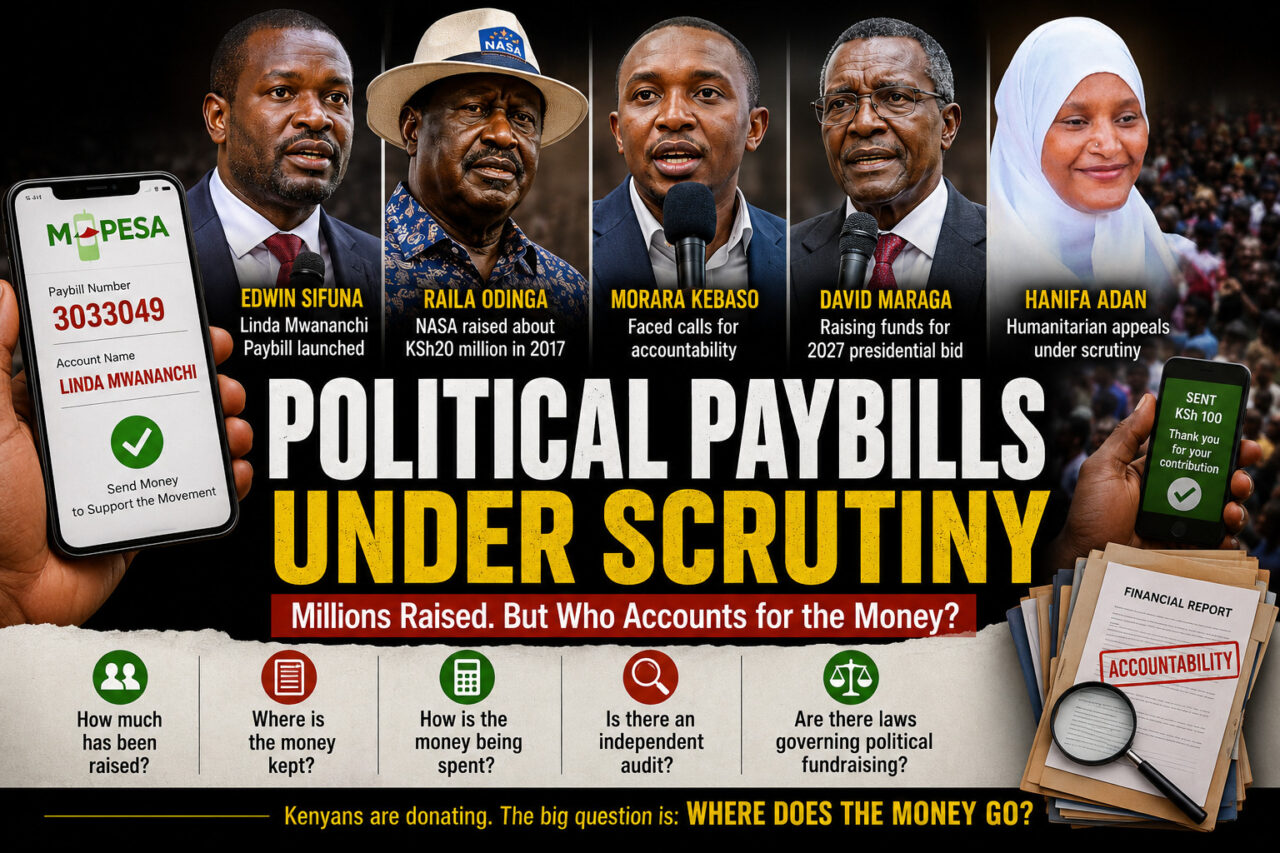
As politicians increasingly turn to M-Pesa Paybills to fund campaigns and political movements, one question continues to surface among Kenyans: Who accounts for the millions raised from the public?
The debate has resurfaced following the launch of Nairobi Senator Edwin Sifuna’s Linda Mwananchi Paybill, which attracted thousands of donations within hours.
According to Sifuna, the Paybill raised KSh519,144 from 9,419 contributors in about 12 hours. He said the money will support transport, logistics, rallies and other activities as the Linda Mwananchi movement tours the country.
Speaking after the launch, Sifuna said the Paybill is registered under his name because the movement is yet to become a registered political party. He also promised accountability for every contribution received.
His assurance, however, has reignited a familiar debate that has followed almost every major political fundraising campaign in Kenya over the years.
Many Kenyans support citizen funded politics, saying it frees leaders from dependence on wealthy financiers. But others argue that once money starts flowing, contributors deserve to know how every shilling is spent.
The conversation is not new.
In 2017, the National Super Alliance (NASA), led by Raila Odinga, launched a Paybill and appealed to supporters to finance its presidential campaign.
The coalition reportedly raised about KSh20 million within the first week through public contributions.
But after Raila withdrew from the repeat presidential election, some contributors demanded refunds, saying the campaign they had supported had not proceeded as expected.
Responding to the criticism, Raila said the coalition had already used the money for campaign activities.
“We are not a bank. We were using the money as it came in,” Raila said at the time.
His remarks sparked widespread debate over whether politicians should publish audited reports after raising money from members of the public.
Years later, activist turned politician Morara Kebaso found himself facing similar questions.
Morara appealed to Kenyans to help finance his civic education tours and political engagements through public donations.
Thousands contributed.
However, as the fundraising gained momentum, supporters began asking how much had been collected and how the money was being spent.
In response, Morara published expenditure breakdowns and later offered refunds to contributors who were dissatisfied.
Human rights activist Hanifa Adan has also faced demands for accountability despite raising money largely for humanitarian support, medical appeals and assistance to families affected by anti government protests.
While Hanifa has regularly shared updates on how donations were used, every new fundraising drive has attracted fresh scrutiny from Kenyans seeking greater transparency.
Former Chief Justice David Maraga has also embraced grassroots fundraising as he prepares for the 2027 presidential race. His campaign has urged Kenyans to support it through small public donations, saying the goal is to build an independent movement funded by ordinary citizens.
The growing popularity of political crowdfunding has exposed a gap in public accountability.
Unlike charitable organisations, political movements are not always required to publish detailed financial statements showing how much they collected, what they spent and what balance remains.
As a result, contributors often rely on updates voluntarily provided by those collecting the money.
Governance experts have previously argued that transparency is essential if public confidence in political fundraising is to be maintained.
For many Kenyans, the issue is no longer whether politicians should ask for public donations.
The bigger question is what happens after the money lands in the Paybill.
As more politicians embrace citizen funded campaigns ahead of the 2027 General Election, the demand for openness may prove just as important as the fundraising itself.
Whether it is Sifuna’s Linda Mwananchi movement, Maraga’s presidential bid or any future political campaign, many contributors now expect more than a simple thank you message after making a donation.
They want to know where their money went.