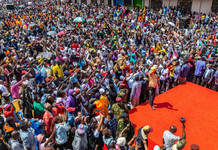
Homa Bay Governor Gladys Wanga has defended the county’s road network after images showing dusty and rough sections of roads during a recent political tour sparked online comparisons between the county and Yemen.
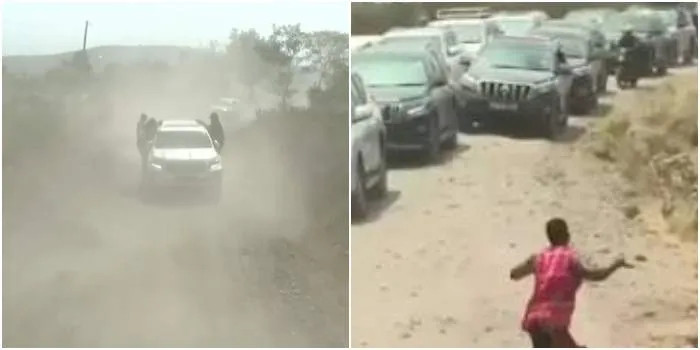
The debate followed a tour of Homa Bay by the Linda Mwananchi team, during which images of roads in parts of Suba South circulated widely on social media. Some Kenyans used the images to mock the state of infrastructure in the county, with comparisons to conflict-affected parts of Yemen drawing particular attention.
Wanga has now pushed back against the criticism, arguing that the condition of some roads reflects years of underinvestment rather than a failure by residents of Homa Bay.
In a statement titled “Beyond the Dust: Homa Bay’s Long Road from Marginalisation to Transformation,” the governor said the images had unintentionally exposed a problem residents have lived with for decades.
“The dust on the Mbita–Sindo–Kiabuya–Sori corridor tells a story. But it is not the story of a people who have failed. It is the story of a region that has waited far too long for the infrastructure required to unlock its potential,” Wanga said.
She said the condition of roads in parts of Suba South affects residents in practical ways, including access to markets and services and the cost of transporting goods.
The 74-kilometre Mbita-Sindo-Kiabuya-Sori road has in fact been under a national government road programme. The Ministry of Roads and Transport announced the upgrading of the road to bitumen standards in 2023, saying the project was expected to improve transport of fish and agricultural produce and open up the area to investment.
The road has also featured among infrastructure projects being pursued in the county. Homa Bay’s official county publication has listed the completion of the Sori-Magunga-Sindo-Mbita road among projects the county leadership has been engaging the national government on.
Wanga’s argument is that such a major road cannot be fixed through county resources alone.
She pointed to the history of the project, saying the road was first awarded in 2016 but stalled after only a section had been completed. It was later re-awarded in 2020.
The governor said works have since resumed, with sections of the road now being upgraded.
The national government has previously said the project is intended to improve connectivity in the region and support the movement of fish and farm produce.
A political tour that became an infrastructure debate
The road controversy came in the middle of an increasingly political period in Nyanza.
Linda Mwananchi, a political movement associated with Edwin Sifuna and other leaders, has been touring different parts of the country ahead of the 2027 General Election. Homa Bay has been one of the areas targeted by the movement.
A previous visit by Siaya Governor James Orengo and the Linda Mwananchi team to Homa Bay in May also attracted political attention after Orengo alleged that his convoy was attacked during the tour. Reports at the time said the incidents occurred around Mbita and Sindo.
The latest road images therefore landed in an already politically charged environment.
But beyond the political arguments, the condition of some roads has raised a genuine question about infrastructure in Homa Bay.
Wanga acknowledged that the county still has a significant infrastructure deficit but argued that the situation should be viewed against the region’s history.
She said Homa Bay, like other historically marginalised areas, had experienced limited investment in infrastructure over several decades.
The governor also defended devolution, arguing that counties now have a greater say in deciding development priorities and receive resources directly under the constitutional system.
At the same time, she credited ongoing national government projects for changing the infrastructure picture in parts of Homa Bay.
The Mbita-Sindo-Kiabuya-Sori road is not the only major road project underway in the county. The national government has also announced works on the 53-kilometre Mfangano Island Ring Road.
Other infrastructure projects have also been announced or pursued in the county, including roads linking different parts of Suba and other constituencies. Recent reports indicate that earthworks have started on the Lwanda-Osodo-Kanyakiamo corridor, while tarmacking works on the Tonga-Kisaku-Osiri road were launched in July.
‘We are not embarrassed’
Wanga’s response was also political, particularly in defending Homa Bay against the ridicule that followed the road images.
She said residents should not be ashamed of the problems they have inherited.
“We are not embarrassed by that history,” she said, arguing that the images of poor roads should instead draw attention to the longstanding infrastructure gap.
Her statement also invoked the political history of Nyanza, mentioning former leaders Tom Mboya and Jaramogi Oginga Odinga and their roles in Kenya’s early post-independence politics.
She further linked the region’s development ambitions to the political legacy of former Prime Minister Raila Odinga.
However, her comments come at a time when Homa Bay is increasingly receiving attention for new infrastructure projects.
In 2025, Wanga highlighted additional road and infrastructure projects in the county, while national government officials have continued to announce major developments in the region.
So while the social media debate has reduced the issue to pictures of dusty roads and the “Yemen” comparison, the reality on the ground is more complicated.
Some roads in Homa Bay remain in poor condition. At the same time, major projects are either under construction, being revived or awaiting completion.
For residents who use these roads every day, the argument is less about how the county looks in a viral video and more about when the promised infrastructure will actually be completed.
That is ultimately where the debate over Homa Bay’s roads is likely to remain: not on social media, but on the roads themselves.