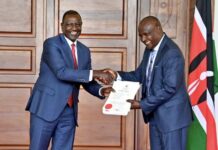
The usually bustling streets of Bukavu, with their motorcycle taxis and market chatter, were unusually tense on Wednesday just hours after Democratic Republic of Congo President Felix Tshisekedi and Rwanda’s Paul Kagame signed the highly publicized Washington Accords, a deal billed as the region’s best chance at peace in decades.
The accord, unveiled at a summit hosted by US President Donald Trump in Washington, promises a permanent ceasefire, the disarmament of non-state armed groups including the M-23 militia, and an economic partnership that opens the door for U.S. companies to extract minerals from eastern Congo’s rich reserves.
But while pens signed the documents thousands of miles away, in Bukavu, the mood was anything but celebratory.
“This is not for us” – DRC human rights defenders skeptical
Skepticism is rising across civil society circles in the DRC. Some defenders of rights believe the accord glosses over a deep, painful conflict history that has created root causes to feed cycles of violence for over 20 years.
Nobel Peace Prize laureate Dr. Denis Mukwege, often considered the moral voice of eastern Congo, did not mince words.
“This is an agreement which is made, not for us,” Mukwege said. “Everything that is done for you, without you, is not done for you. This peace agreement for us is not inclusive. Civil society is not involved. As a result, we consider it a peace agreement that is not sustainable.”
For many in Bukavu, Mukwege’s critique speaks directly to their fears – that high-level political deals have too often failed to protect those who live closest to the conflict.
Leaders hail deal as a turning point
The tone, however, was decidedly different at the signing ceremony in Washington.
Tshisekedi described the accord as “a turning point”, explaining that it is not a symbolic gesture: “The Washington agreements are not yet another document. They bring together a declaration of principles.”
Kagame echoed the sentiment, warning of challenges ahead but insisting Rwanda would honour its obligations. “There will be ups and downs ahead. Rwanda, I know, will not be found wanting,” he said.
Hosting the summit, President Trump injected his trademark bravado into the moment.
He said, “They have spent a lot of time killing each other and now they will spend a lot of time hugging, holding hands and taking advantage of the USA like other countries do.
Kenyan President William Ruto, who has played a diplomatic role in the region, promised to support the agreement and said: “We will spare no effort to ensure this agreement is fully realised… to secure peace and unlock the region’s economic potential.”
A lucrative mineral deal at the heart of the pact
In addition to peace, the agreement has a bilateral framework between the DRC and the United States on extracting minerals, an element already stirring controversies among analysts and activists.
“We’ll be sending our biggest and greatest companies over to the two countries, and we’re gonna get the rare earth minerals, and everybody’s gonna make a lot of money,” President Trump added.
For many Congolese communities whose conflict has been fueled by the very same minerals, the statement did little to inspire confidence.
Fresh violence overshadows peace promises
As leaders were assuring the world of a new dawn, residents of Bukavu woke up to reports of new clashes in the nearby Kaziba, Katogota, and Lubarika areas, which have been repeatedly attacked over the years.
The Congolese army and the M-23 militia now accuse each other of attempting to sabotage the peace deal between them. Word of an imminent forced disarmament of armed groups does nothing but heighten fears among civilians.
In the Ibanda neighborhood of Bukavu, one shopkeeper summed up the day’s mood: “If there is peace, we will know it here first. Not in Washington.” As the ink dries on the Washington Accords, the real test begins on the ground where hope competes with history and the residents of eastern Congo anxiously wait to see if this agreement will finally silence the guns or be yet another promise made from afar.