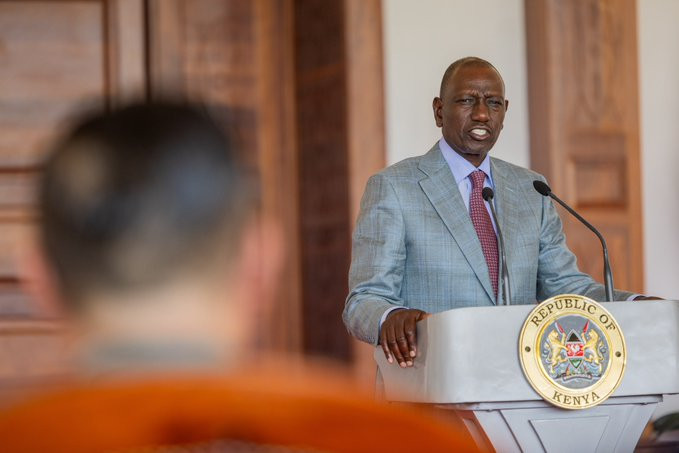
President William Ruto has blamed Kenya’s long-standing emphasis on academic subjects such as English, History and Geography for contributing to a shortage of technicians and other skilled workers.
Ruto said the country had for years created the impression that academic success was the main route to a good career, while technical education was left to students considered unable to make it to university.
Speaking at State House, Nairobi on Thursday, the President said the mindset had affected the country’s ability to produce enough people with practical skills.
“For a very long time, as a country, we created the impression that for you to be successful, you must pass English, and History and Geography,” Ruto said.
He recalled his time at the University of Nairobi, where he said he was in a large class of about 800 students studying sociology.
Ruto said he respected sociology, philosophy and other academic disciplines but questioned whether the country was producing enough people capable of putting projects into practice.
“But you see, we didn’t have the men and women to do things,” he said.
The President said the situation influenced his decision to push for greater emphasis on technical education when he served as Minister for Higher Education.
He said he held discussions with university vice chancellors and pushed for the creation of a bigger pool of technicians and technologists.
“That is how we began to put as much emphasis on technical education,” he said.
Ruto also recalled deliberately attending graduation ceremonies at technical training colleges from 2013, saying the events were not considered as prestigious as university graduations.
He said this reflected a wider attitude in society that technical education was meant for students who had failed academically.
“It is not very prestigious to attend a technical training college graduation, but it is prestigious to attend a university graduation,” Ruto said.
“We created in the minds of the people of Kenya that technical education, education that gave our young men and women skills, was meant for failures. How sad and how unfortunate!”
The President linked the mindset to shortages of workers such as plumbers and electricians, saying Kenya did not have enough people with technical skills to meet its needs.
Kenya has in recent years increased investment in Technical and Vocational Education and Training (TVET), with the government seeking to produce workers with skills that match the labour market.
In 2024, Ruto said the government had allocated Sh28.3 billion to TVET institutions and planned to recruit 2,000 tutors. He also announced a Sh13 billion partnership with China to equip 70 TVET institutions.
The President has repeatedly argued that technical training is critical to Kenya’s development, particularly as the country expands infrastructure, manufacturing, construction and other sectors requiring skilled workers.
The shift is also reflected in the Competency-Based Education system, which places greater emphasis on practical skills, science, technology, engineering and mathematics alongside other learning pathways.
Ruto said the country must continue changing its attitude towards technical education so that young people can acquire skills that are directly useful in the workplace.
The President’s remarks come as Kenya continues to expand its technical training institutions as part of efforts to address skills gaps and prepare young people for emerging employment opportunities.