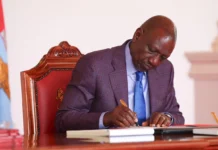
Kenyan police officers may soon spend less time worrying about fuel shortages and more time actually doing their jobs, thanks to a sweeping set of reforms announced by President William Ruto on Tuesday, December 2, at State House Nairobi.
While receiving the Jukwaa la Usalama report from Interior Cabinet Secretary Kipchumba Murkomen, the President acknowledged what officers on the ground have been saying for years: constant fuel shortages and ageing vehicles have made even the simplest operations a struggle.
To change that, Ruto revealed that the government is expanding its vehicle purchase plan from the earlier target of 1,200 units to 3,000 new police vehicles.
“We currently have a budget for 1,200 vehicles, but we aim to buy 3,000 to improve mobility,” he said, adding that the government is also putting systems in place to ensure the vehicles are always properly fuelled. “Officers should be able to carry out their duties without interruption.”
Murkomen’s report paints a clear picture of why change is needed. The current allocation of 450 litres of fuel per vehicle each month simply doesn’t match the realities officers face whether it’s long distances in rural outposts or the heavy workload in busy towns. Repairs, too, have been taking far too long, often grinding operations to a halt.
In what may be the most ambitious part of the reforms, Ruto announced that the police service will begin adopting electric vehicles.
“We now have electric vehicles,” he said. “We’ll go back to electric so that in the evening an officer can just charge the vehicle and get on with work.”
The move signals a significant shift toward modernizing the police fleet while cutting long-term fuel costs.
More Than Just Cars: New Stations, Promotions, and Digital Records
Transport, however, is just one piece of the broader overhaul.
Ruto also disclosed plans to put up 900 new police stations across the country within two years. The rollout will be shared across government channels:
300 stations built using NG-CDF funds,
300 through the government’s housing programme, and
300 by the Interior Ministry.
In a morale-boosting announcement, the President confirmed that every police officer will be promoted by at least one rank by June 1, 2026. This includes officers who have crossed age 50 but remain stuck at the constable level.
The reforms also include a push to digitise police operations nationwide. Key records including OB entries will move to digital platforms. To make that possible, every chief across the country will receive a tablet for filing reports online.