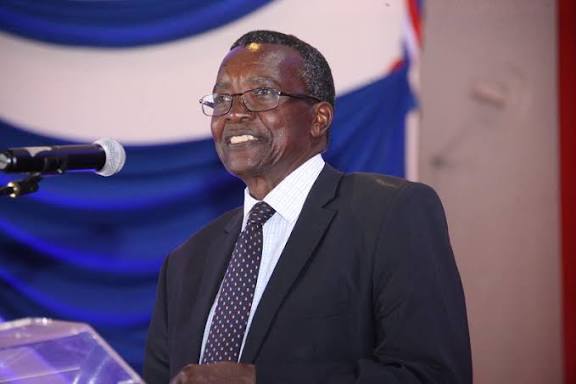
Presidential candidate and former Chief Justice David Maraga has accused President William Ruto’s administration of rushing to enact contentious bills into law without sufficient public input, warning that the move threatens constitutional freedoms.
Targeting a government “rush” to enact legislation at a forum in Nairobi on Tuesday, Maraga accused the government of “fast-tracking” bills, including the contentious Computer Misuse and Cybercrimes (Amendment) Act, which he asserted can be used to muzzle opposition.
The government is conscious that individuals are rushing to the courts hurriedly. They are moving fast so that when we obtain court orders, matters will have passed us,” Maraga told journalists.
His comment comes after President Ruto signed eight bills into law, namely National Land Commission (Amendment) Bill, 2023, Land (Amendment) Bill, 2024, Wildlife (Amendment) Bill, 2023, Computer Misuse and Cybercrimes (Amendment) Bill, 2024, National Police Service Commission (Amendment) Bill, 2024, Air Passenger Service Charge (Amendment) Bill, 2025, Virtual Asset Service Providers Bill, 2025, and Privatisation Bill, 2025.
In a since-withdrawn provisionally published statement on his official X account, President Ruto had explained the new legislation as being aimed at “affirm our collective commitment to right historical injustices, consolidate equity and openness, and drive our national development agenda.”
But Maraga argues some of the laws, such as the amendment on cybercrimes, were hurried through in lack of adequate public consultations and present an online liberty threat.
The cybercrimes act empowers the state agencies to access or block online accounts that are suspected of posting false information or threats to the cybersecurity.
The act further enhances the definition of phishing to include fraudulent telephone calls and criminalises unauthorized SIM swaps.
Maraga was also going for the Privatisation Bill, 2025, which allows the government to sell or assign ownership of state entities without fresh permission from Parliament. He warned that these provisions lock in so much unchecked power in the Executive.
He was concerned that the cybercrimes law would be used to justify blocking websites or suspending social media platforms such as Facebook, YouTube, and TikTok all in the name of regulating objectionable content.
“These amendments are unconstitutional, null, and void. President Ruto has lost legitimacy to continue ruling this country,” Maraga declared, and the laws are contrary to the spirit of the Constitution.
He added opposition leaders, civil society groups, and cyber activists were already queuing up to take the new law to court.
“We can’t allow these freedoms to slip quietly away. Channels already exist to petition the court to act, and we strongly applaud them,” he added.
Parliamentary documents state, however, that the Computer Misuse and Cybercrimes (Amendment) Bill, 2024 had already been gazetted on 9th August 2024 following public consultation and vetting by the Committee on Communication, Information and Innovation of the National Assembly.
The Bill became law on 8th October 2025 and was signed into law by President Ruto on 15th October.