Agriculture and Livestock Development Cabinet Secretary Mutahi Kagwe has announced that Kenya will soon launch the JobsConnect Compact, becoming the first African nation to complete the global framework aimed at creating six million new, greener and dignified jobs by 2030.
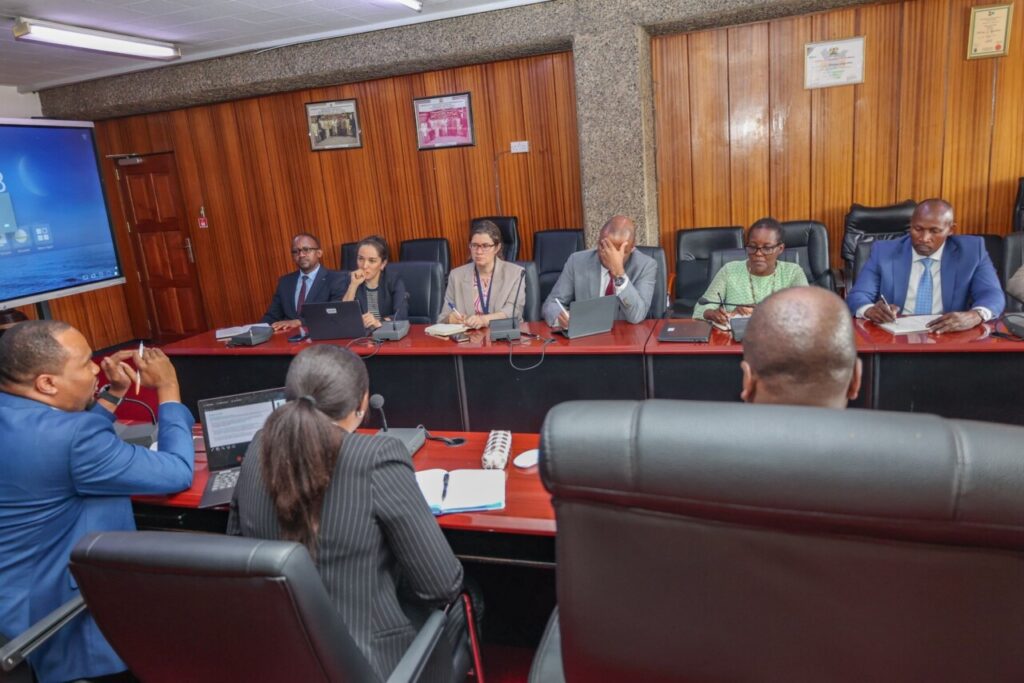
Kagwe made the announcement during a briefing with leaders from the World Bank Regional Office—Dr. Eliot Mghenyi, Ghada Elabed, and James Musinga—as well as founding members of the MADE Alliance, including representatives from Mastercard, Equity Bank Kenya, Microsoft, and the Kenya National Farmers’ Federation (KENAFF).
Also in attendance were Florence Kariuki, Daniel Huba, Jane Gidali (Mastercard), Magdalene Alukhava (KENAFF), and Priya Chana, Nawa Lubasi, and Harold Mate (Equity).
The CS confirmed that all agricultural digitisation initiatives have been consolidated under the Kenya Agriculture Data and Information Centre (KADIC), which will serve as the central data hub, integrating systems such as KIAMIS.
He further announced that the Agriculture Information and Resource Centre (AIRC) will be rebranded as KADIC to eliminate duplication and strengthen real-time connections between farmers, counties, cooperatives, markets, and processors.
KADIC Director Betty said the Centre will lead the rollout of the Digital Agriculture Roadmap (DAR), set for launch next year. Juma Salim, KADIC’s Director of Digital, added that unifying data from the Ministry’s 31 parastatals will enable farmers to access timely and actionable information.
The JobsConnect Compact prioritises job creation, food and nutrition security, import substitution, and export growth.
Its targets include creating 5.3 million new and improved jobs, reducing food insecurity by 10 million people, cutting imports by USD 2–3 billion, and boosting agricultural export earnings by USD 5 billion.
Kagwe highlighted the central role of digital agriculture in transforming farmer incomes and attracting young people into a tech-driven agricultural sector.
He also noted a major human resource transition ahead: 30% of departmental heads are nearing retirement, 20% have already exited, and over half of the ministry’s workforce is expected to leave within two years.
He described this shift as an opportunity to rebuild capacity through Agri-Connect, agri-preneur training, Kenya Agriculture College, and digitised soil testing.
Mastercard presented its digital payment infrastructure, noting that only 2% of farmer transactions currently pass through M-Pesa, limiting financial visibility.
Equity Bank reaffirmed agriculture as a core pillar of its strategy, supporting efforts to increase yields, savings, and long-term farmer wealth.
The CS reiterated that agriculture cannot thrive under commercial interest rates of 18–19%, calling for guaranteed agricultural credit at 5% as the only sustainable path forward.