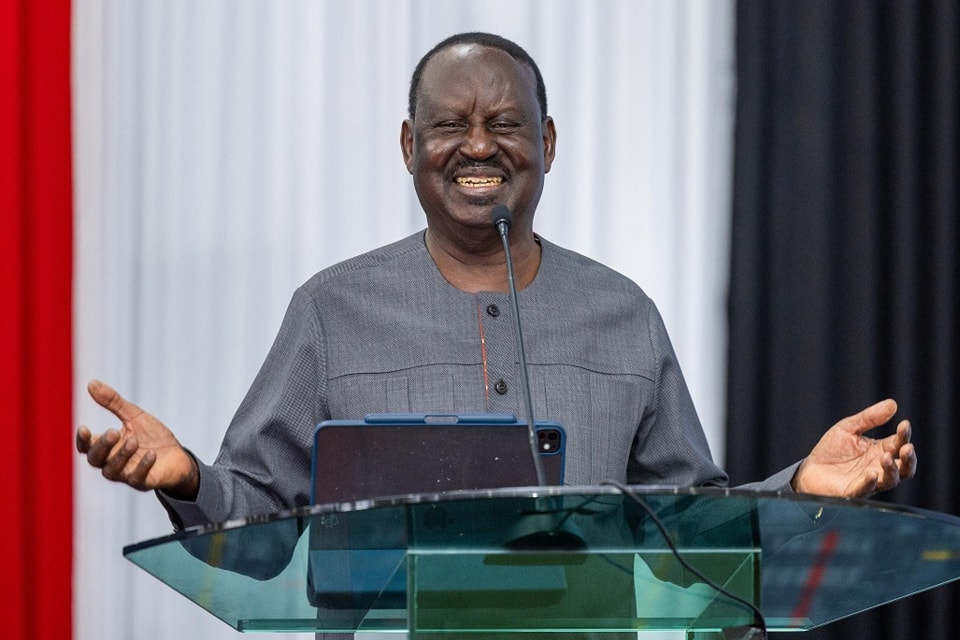
Former Prime Minister Raila Odinga has called on the government to adopt a citizen-centered approach in service delivery, saying national unity, inclusive development, and transparent leadership must guide the country’s path forward.
Speaking during the Third Retreat and Mid-Term Review of the National Executive, Odinga acknowledged the opportunity to share his views as an observer and concerned Kenyan, following the recent Memorandum of Understanding (MOU) between the ODM and UDA parties that sought to promote political stability and issue-based collaboration.
“No matter our disagreements, our visions and disappointments, we have to have a country first,” Odinga told President William Ruto and cabinet officials. “We may hold as lofty visions as we wish, but without a country to implement the ideas, they will remain mere wishes and deferred dreams.”
Odinga emphasized that the government must do more to carry the people along in designing and implementing policies, warning that a growing perception of exclusion is undermining trust in public institutions.
“One of the lessons I hope we’ve picked is that without the people’s understanding and ownership of policy design and execution, the belief will persist that government is not delivering,” he said.
The ODM leader also addressed recent national unrest and public dissatisfaction, cautioning that while some may exploit the turmoil for political gain, the majority of Kenyans are seeking stability, solutions, and a responsive leadership.
He acknowledged improvements in the proposed 2025/26 budget, saying it shows signs of responding to citizen frustrations, but added that more must be done—not to win elections, but because “it is the right thing to do.”
Odinga further called for urgent reform of government systems to reflect the needs and realities of Kenya’s youthful population, noting that the public service is ageing while its “customers” are young, bold, and technologically savvy.
“This restless population needs a government that is easier and faster to navigate, less complicated and bureaucratic, and more efficient,” he noted. “The job group mindset and patronizing attitudes will not work.”
He challenged both the National Executive and County Governments to prioritize institutional reform, fight corruption, and ensure public funds are well managed, especially in an era where citizens can easily trace financial misuse.
“Corruption and wastage in the public sector remain a serious threat to progress. It has to be punished—and be seen to be punished,” he stated firmly.