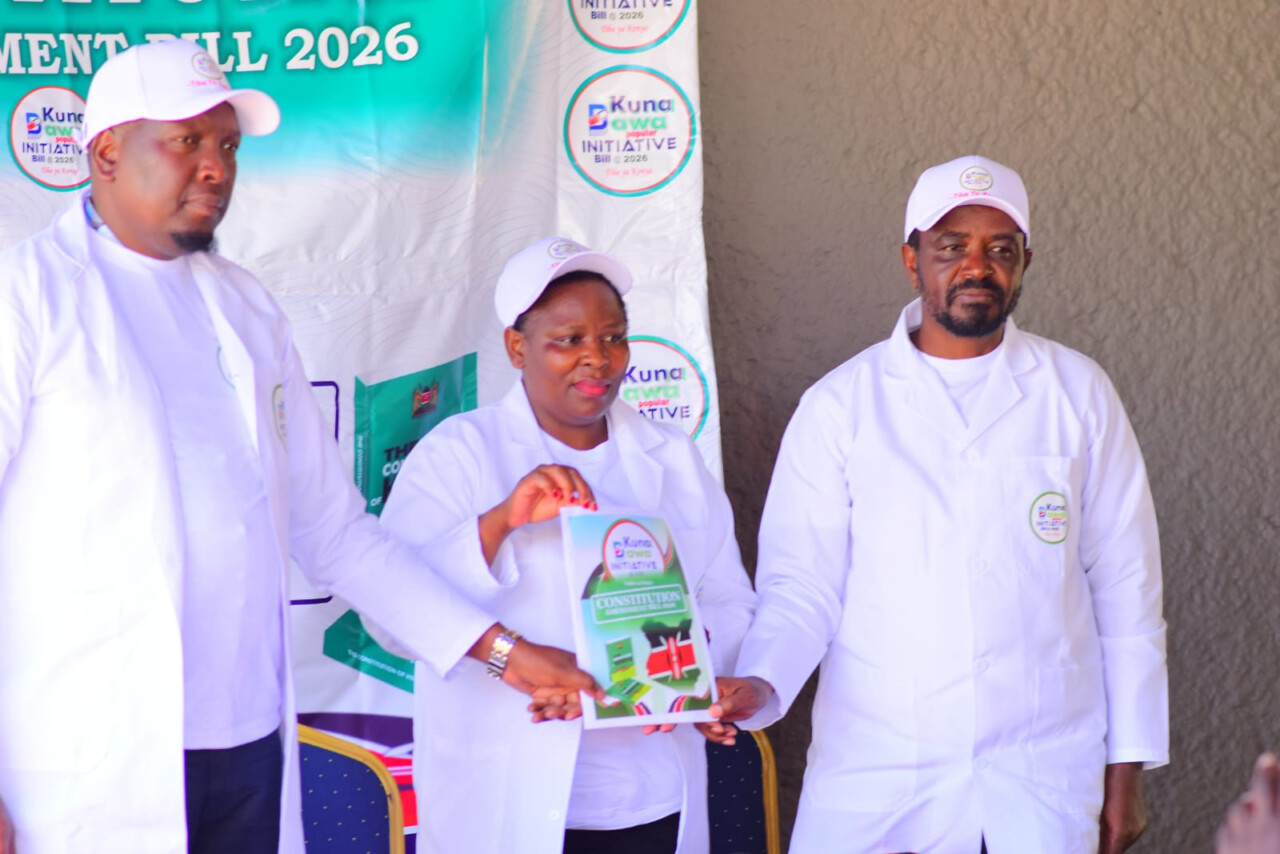
Kuna Dawa, a civic movement, is seeking to effect wide-range changes to the country’s constitution, a move it hopes will strengthen oversight, improve economic coordination, deepening devolution, and enhancing accountability.
The initiative, presented as a single package of reforms, calls for national dialogue and broad public engagement through the Article 257 popular initiative process.
“The proposed changes aim to modernize Kenya’s governance architecture while ensuring stronger institutions, improved service delivery, and inclusive national development,” said Charles Gichuru, executive director of Kuna Dawa.
Chief among the issues is to cut the size of Parliament from 421 to 235 members. The lower house (National Parliament) would have 188 elected and 12 nominated members.
The Upper House or Senate will consist of 47 elected who will hold final legislative authority on matters affecting county governments and the National Economic Council

Require a temporary transfer of executive authority by the incumbent president to the Chief Justice during the election period to insulate the electoral process from executive influence and bolster public confidence in free and fair elections.
Money under one roof
The proposal is calling for the creation of a National Economic Council (NEC) chaired by the President and including the Deputy President, Prime Minister, Deputy Prime Minister, 16 Executive Economic Block Coordinators, the Principal Secretary of the National Treasury and the Attorney General.
The proposal seeks to 5 a restructured national development budget, allocating 20 percent to flagship national projects and 80 percent to County Economic Blocks for regional infrastructure and investment.
The deputy prime minister will be NEC’s accounting officer, effectively cutting executive’s influence on budgetary allocations.
Furthermore, Kuna Dawa is proposing the formation of County Economic Blocks of three contiguous counties to coordinate trade, infrastructure, and joint investments
Each block would elect an Executive Economic Block Coordinator to convene governors and represent the block in national economic discussions.
The constitutional amendments want Constituency Development Fund (CDF) replaced with a Ward Development Fund to channel resources directly to wards and strengthen grassroots decision-making.
Prime minister and leader of opposition offices
Kuna Dawa wants offices of Prime Minister and Deputy Prime Minister offices established. The two will be selected by a ruling political party or coalition.
The Prime Minister is expected to lead government business in Parliament with the Deputy Prime Minister overseeing the National Treasury and economic planning under the NEC.
The proposed bill seeks to create the Office of the Leader of Opposition and Deputy Leader of Opposition, to be held by the presidential runner-up and deputy runner-up, respectively. This is aimed at institutionalising structured opposition and democratic accountability.
Split Nairobi into two regions
The citizen led movement intends to split Nairobi County into two semi-autonomous regions — Nairobi North and Nairobi South — each overseen by a deputy governor to improve service delivery and infrastructure planning.
Moreover, the proposal also seeks to designate Narok and Kajiado as protected counties with gubernatorial and senatorial positions reserved for local communities to safeguard indigenous representation.
Furthermore, the Bill proposes devolution of certain security coordination functions to county governments under governors’ leadership and remove supervisory or coordinating roles previously exercised by the Office of the County Commissioner.
The country has witnessed bitter fallouts between presidents, governors, and their deputies. To resolve this quagmire, the bill introduces provisions allowing dissolution of the executive in cases of irreconcilable deadlock to prevent governance paralysis.
Kuna Dawa is also advocating for the merging of the Kenya National Human Rights Commission, the Commission on Administrative Justice and the National Cohesion and Integration Commission into a single constitutional commission to reduce overlap and strengthen promotion of human rights, administrative justice and national cohesion.
It therefore proposes the creation of a Unified Oversight Authority complete with investigative, auditing, prosecutorial, and asset‑recovery functions to improve enforcement against economic crimes.
The movement invites citizens, civil society, professional bodies, political leaders, and other stakeholders to participate in consultations.