
The Kenya Revenue Authority (KRA) has revised the minimum yield applicable to consolidated cargo imported by small-scale traders, in a move aimed at simplifying customs clearance and making the process more predictable for legitimate traders.
In a press statement dated August 27, 2026, KRA said it recognises the importance of cargo consolidation for small-scale traders who pool shipments to access more affordable logistics and streamline the importation process.
The tax authority explained that customs valuation of imported goods is governed by Section 120 and the Fourth Schedule of the East African Community Customs Management Act.
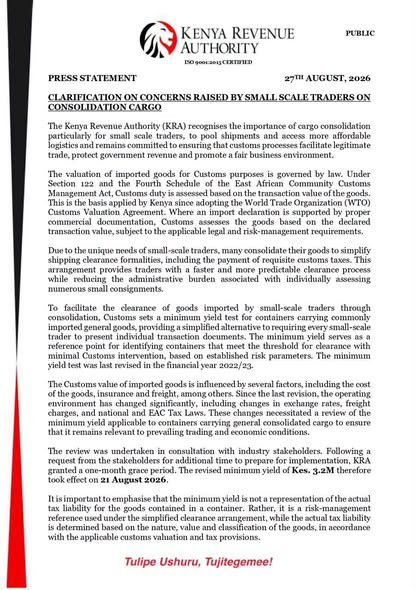
Where an import declaration is supported by proper commercial documentation, KRA said Customs will generally determine the value of goods based on the declared transaction value, subject to applicable legal requirements and risk-management procedures.
Under the simplified trade facilitation arrangement, KRA allows small-scale traders to consolidate their goods to ease shipping and customs clearance.
The arrangement provides traders with a simpler and more predictable clearance process while reducing the administrative burden associated with processing numerous small consignments individually.
However, KRA said the minimum yield is used as a reference point for identifying containers that may require further scrutiny or Customs intervention based on established risk parameters.
The authority said the minimum yield has been revised due to changes in the cost of goods, insurance and freight, as well as changes in exchange rates, shipping charges and applicable East African Community (EAC) taxes and levies.
KRA said the revised minimum yield for consolidated cargo took effect on August 21, 2026, following consultations with industry stakeholders.
The authority stressed that the minimum yield does not represent the actual tax liability for goods contained in a consolidated shipment.
Instead, it serves as a risk-management tool used to identify consignments that may require verification. Where applicable, the actual tax liability will continue to be determined in accordance with customs valuation and tax provisions.
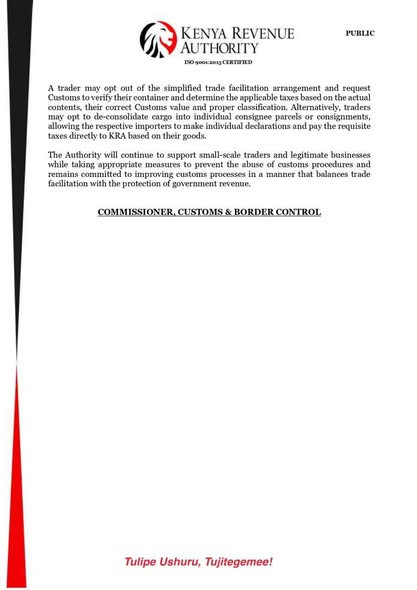
KRA said traders who do not wish to use the simplified trade facilitation arrangement may opt out and request Customs to verify their containers and determine applicable taxes based on the actual contents and correct Customs value.
Traders may also choose to deconsolidate cargo into individual consignee parcels or consignments, allowing the respective importers to make individual declarations and pay taxes directly to KRA based on their goods.