Kenya has made a big bet on becoming the go-to destination for Artificial Intelligence Investment in Africa, and it is doing so by leveraging its traditional advantage in renewable energy as the basis upon which a new industrial strategy will be built.
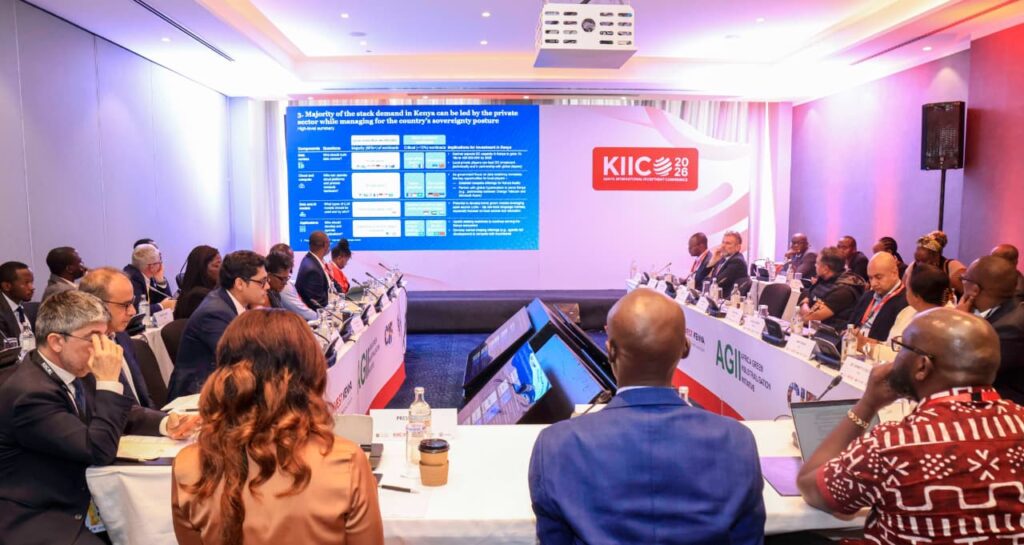
At the Kenya International Investment Conference (KIICO) 2026, the high-level AI Roundtable, led by the Office of the Special Envoy on Technology, KenInvest, and the American Chamber of Commerce, gave a glimpse into what path the country might be likely to take.
The discussion centered around how the country might be able to capitalize on becoming a full-stack destination for Artificial Intelligence.
The big difference between Kenya’s pitch and others comes in the form of understanding that, in today’s day and age, Artificial Intelligence is no longer just a software play; rather, it’s becoming an infrastructure play, one that’s linked to issues like electricity, capital expenditure, regulatory frameworks, data, and human capital.
The country’s advantage, according to those attending, comes in the form of its traditional advantage in renewable energy, one that’s now becoming more and more relevant given that many global markets for Artificial Intelligence.
These figures, mentioned at the roundtable, show that the market is starting to move. The strategic brief also mentioned the first hyperscaler deployment in the region, with $50 million in risk capital to get things going. Future investments of $250 million to $300 million in AI factories were also mentioned, along with other infrastructure plays involving cloud, data centers, and sovereign stack deployments. These are early-stage market figures, but they show that Kenya is being taken seriously as a future computing location.
Government policy is now an important commercial consideration. Investors need policy clarity without overreach. The policy recommendations included developing a sandbox framework to be deployed over 90 days to allow innovators to test systems, strengthening existing institutions rather than building new bureaucracies, and developing interoperable digital public infrastructure under what is being termed the “Kenya Stack.” This is important to investors because it suggests that the state is trying to reduce friction without overreaching.
Another interesting commercial consideration was the logic of localization. The high cost of access to frontier models is currently being cited by innovators. Therefore, reaching one million users is currently commercially challenging in Africa. The recommendation is that capital must increasingly support localized AI.
AI models more appropriate to the local bandwidth situation, language, and sectoral needs. Africa cannot just import the economies of Silicon Valley and expect them to work here as they are.
Talent was recognized as a core investment pillar and not a social afterthought. Participants emphasized the need to develop indigenous AI talent, improve the university-industry link, improve the AI competence of the public sector, and leverage the diaspora talent pool. There was some discussion around the attraction of international talent pools with residency and tax benefits, which implies Kenya’s AI ambitions are not just about retaining talent but making Kenya a talent hub as well.
Past Achievements – Building the Foundations
Kenya’s current AI ambitions are a result of a string of achievements in the country’s AI journey so far. In 2025, the government launched the National Artificial Intelligence Strategy (2025-2030) a five-year strategy to establish Kenya as the AI innovation leader in Africa. Some of the flagship projects included the modernization of the country’s digital infrastructure, enhancing the sovereign data capabilities of the country, and applying AI in agriculture, health, and public service delivery.
Universities such as the University of Nairobi and Jomo Kenyatta University of Agriculture and Technology started incorporating AI research into their curriculums, while others such as KEMRI started incorporating AI research in medical studies. Startups and innovation hubs also started to take shape, with initiatives such as LLM Labs Ke using AI models in healthcare, education, and agriculture, touching over 100,000 lives. This was also marked by investments from venture capital, reaching close to $15 million in 2023.
These successes paved the way for what has become a goal for Kenya currently, which includes aligning energy, infrastructure, regulations, research, finance, and skills into a platform that can attract capital from around the world and also promote innovation from local startups.