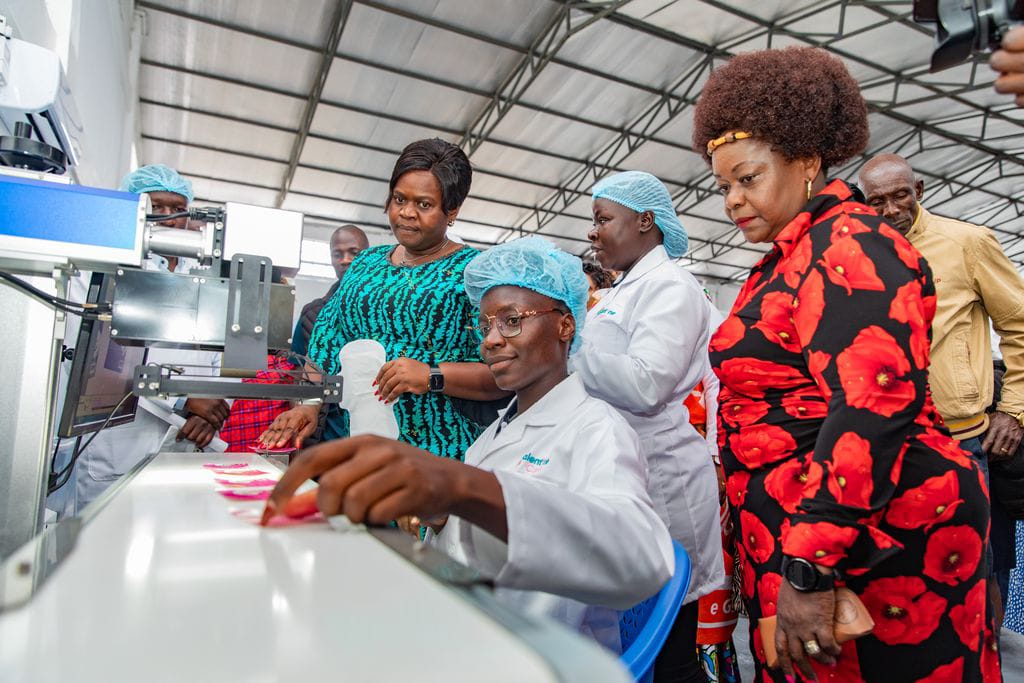
Homa Bay County has risen up to tear down the walls of period poverty by unveiling the Galentine Care Sanitary Pad Factory in Kasgunga Ward, Suba North. Homa Bay County Governor Gladys Wanga opened the facility which is a womens social enterprise that aims to produce affordable, quality sanitary pads while also providing employment to women.
Present were county leaders, MPs, teachers, development partners, students, and local community members. Presentations by girls from Nyamasore Girls Secondary School stressed the hardships girls face when they get their periods and live with no or low resources.
Galentine Care Ltd is more than a factoryit is an employee, owned and women, led business, thus enabling women both to lead and to have financial independence. It is situated in Mbita and makes sanitary pads that are sold at KSh 50 that is 60% cheaper than the market price. Some of the items will be given to schools to aid in reducing menstruation, related absenteeism and girls will be able to stay in classrooms.
“This is not a handout. That is a social enterprise that is in its core a dignified one, ” said Governor Wanga. She talked about the connection between period poverty, teenage pregnancy, and household poverty.
According to Homa Bay, the county has always been the leading area for teenage pregnancies in Kenya, and over 17, 000 cases have been reported in 2024 alone.
Peter Macodida Founder and CEO said a community study that showed that 97% of the women could afford KSh 50 pads. This has been the reason that the factory has taken a market, based approach to the environment. At full scale, Galentine Care intends to expand its 17 trained women workers to over 200 by Year 3, provide 430, 000 women with access to their products and use profits to create jobs, profit, sharing, and free pads in schools.
Besides supporting local suppliers and anchoring industrial development, the factory has passed KEBS and ISO standards and is capable of producing up to 200 pads per minute.
The two co-founders Stephanie March and Tracy Mackavin pointed out that women-led manufacturing can be one way to achieve social and economic transformation.
Mackavin continued to say that this factory is a movement, by which she means that when women decide to take the lead in coming up with solutions for their own communities, then the result is always powerful.
Using Galentine Care as a stepping stone, Homa Bay has become a beacon at the national level of how social enterprise, policy, and community action can be effectively integrated to protect girls’ education and empower women.