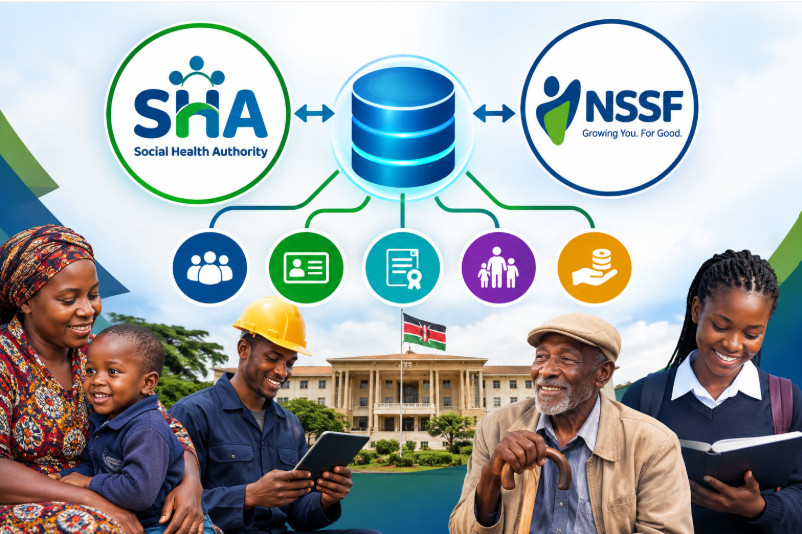
The government is planning to connect the Social Health Authority (SHA) and the National Social Security Fund (NSSF) to a central social protection system to improve how information on beneficiaries is shared across government agencies.
The planned integration will bring together several government databases and systems that currently hold information separately.
They include SHA, NSSF, the Integrated Population Registration Service (IPRS), the National Registration Bureau, Civil Registration Services and various cash transfer and social protection programmes.
The State Department for Social Protection and Senior Citizen Affairs is seeking a consultant to upgrade the Enhanced Single Registry (ESR) and Community Development Management Information System (CDMIS), which will support the planned data integration.
The assignment will involve improving both the front-end and back-end of the two systems and strengthening their ability to exchange information with the other government platforms.
The government expects the integration to make it easier for agencies involved in social protection to share relevant information when identifying and managing beneficiaries.
It is also expected to improve coordination between different programmes instead of having agencies rely on separate systems with limited links to each other.
The project is being implemented under the Second Kenya Social and Economic Inclusion Project (KSEIP-2), which is funded by the World Bank.
KSEIP-2 is aimed at expanding social protection support for vulnerable children, adolescents and working-age adults while improving the systems used to deliver government assistance.
Under the programme, the government plans to expand the Economic Inclusion Programme from five to 20 counties.
The programme will also support selected beneficiaries in developing climate-resilient livelihoods and connect graduates to contributory social insurance schemes.
Other areas of focus include support for vulnerable children and adolescents through programmes targeting malnutrition, education and teenage pregnancy.
The systems component of KSEIP-2 is expected to improve the delivery of social protection programmes and strengthen the government’s ability to respond to climate-related shocks.
The State Department has now invited an individual consultant with relevant technical qualifications and experience to undertake the system upgrade.
The consultant will be selected in line with World Bank procurement procedures.