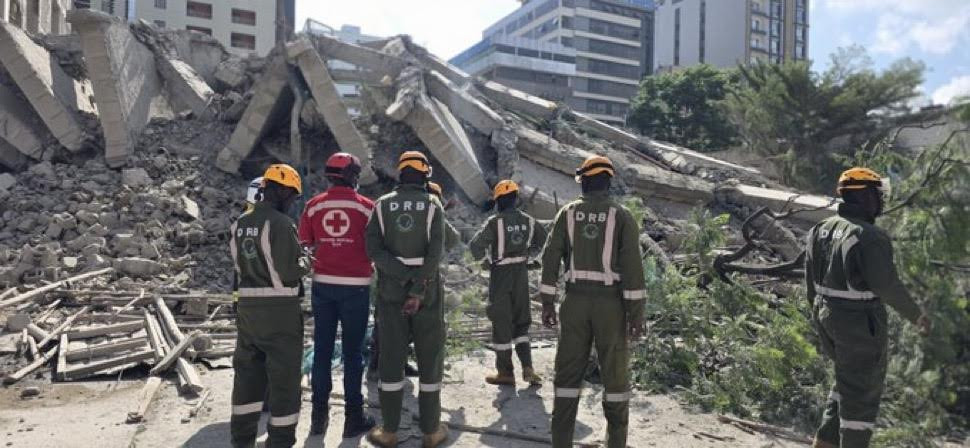
The government has warned professionals involved in the construction of the South C building, which collapsed in Nairobi, that serious action, including deregistration, may be taken if anyone is found responsible.
Delivering a speech at the site where the building had collapsed on Monday, January 5, the Lands and Housing Cabinet Secretary, Alice Wahome, noted that the initial probe had highlighted disturbing irregularities in the building process contrary to the approved plans despite the developers’ acquisition of a legal license to execute the project.
Wahome revealed that a maximum of 12 floors had been approved for such a building by the relevant government agents under her ministry. Nevertheless, developers ended up constructing four more floors, increasing the building beyond 16 floors, and this was right at the core of the tragic event.
“That is where the problem began,” the CS continued. “Those four additional floors were never approved, and our investigations will start from there.”
She said that throughout the process of the development, there had been quality assurance inspections carried out as the law had stated. From the records obtained, at the time of the inspections, the building had only gone up to the third floor; therefore, the development that had been carried out illegally had not been monitored.
“Accountability would not rest with the developer alone. The architects, the contractors, the inspectors, and other professionals who facilitated and turned a blind eye to the illegal activities will also be made accountable,’’ said the Cabinet Secretary.
“But if criminal liability has been established, we shall not hesitate to take measures, including striking professionals off the register,” Wahome said.
She further stated that the ministry is working very closely with other government departments and with professional bodies through a multi-agency team to establish a mechanism for the breaches that occurred.
Her statements were happening at a time when worries about enforcement deficits were rising. Johnson Sakaja, the governor of Nairobi, explained that his government had previously pointed out that this building was disobeying, but its developers paid no heed to enforcement actions.
He also reiterated his demand for county governments to have prosecutorial powers, in order to pursue developers who violate construction laws. He also blamed the Office of the Director of Public Prosecutions (ODPP) for not taking actions on the cases presented to them by the county governments.
The building went down on Friday, January 2, resulting in two deaths. The body of one victim has been retrieved, while search teams are looking for another alleged victim thought to be beneath the rubble.
After the occurrence, the ODPP ordered the Inspector General of Police to investigate the collapse and file a report within seven days. The DPP indicated that statements would be taken from all major players in the matter such as the developer, contractors, as well as the authorities responsible for approvals & enforcement.
“The objective is to ensure those who took part in this disaster have been made responsible in line with the law,” the ODPP stated in their statement on Sunday, January 4. The South C Building collapse, as the inquiry into the matter continues, has raised questions about construction approvals, professionals, and the construction process among Kenyan rapidly growing urban centers.