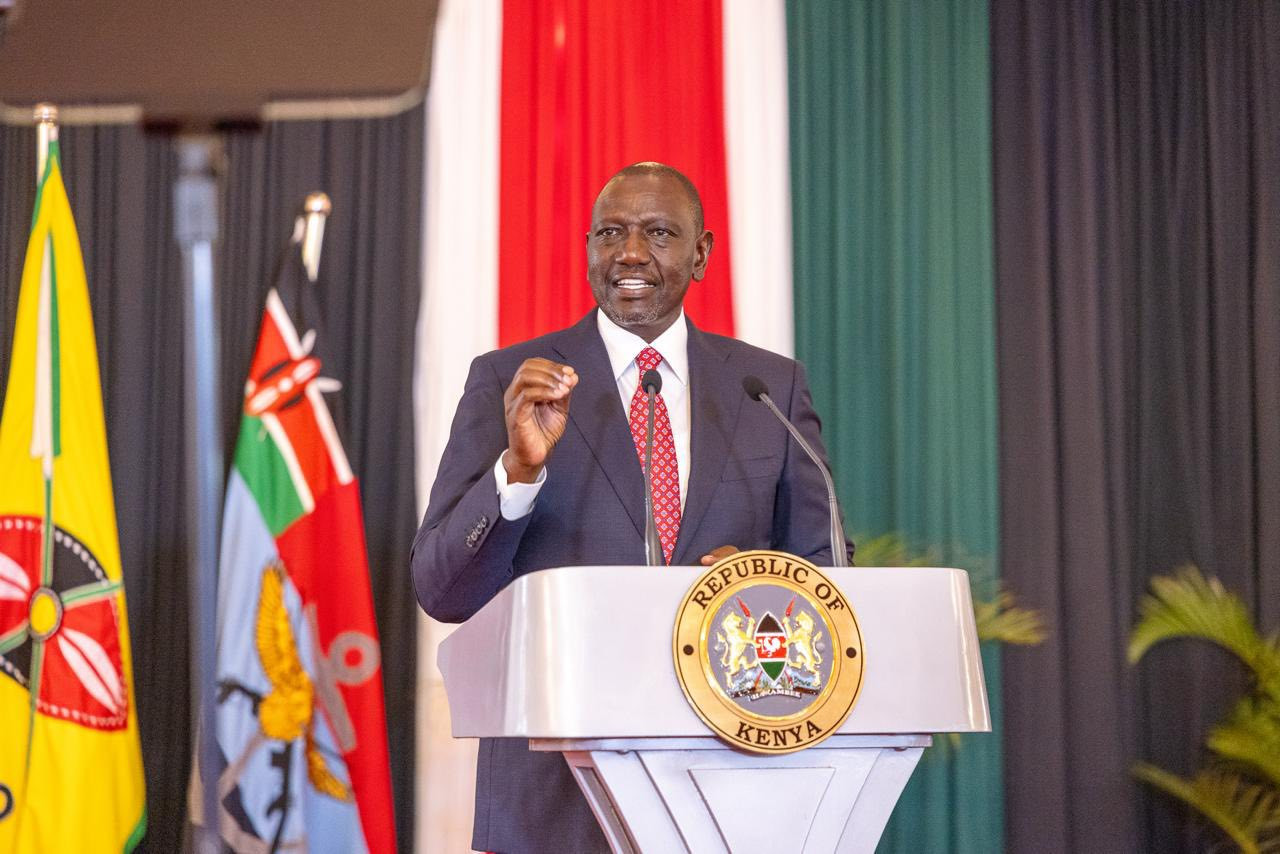
President William Ruto has pledged to halve poverty and unemployment in Kenya as part of an ambitious national transformation agenda, acknowledging that millions of hardworking Kenyans are still struggling to meet their basic needs despite ongoing economic reforms.
In his New Year address, the President said more than 20 million Kenyans remain trapped in economic hardship, with unemployment—especially among young people entering the job market—remaining a major challenge.
“Too many of our young people still wake up every morning without work to go to. This is the reality we are living in,” Ruto said, even as he defended the government’s bottom-up economic interventions aimed at job creation.
The President argued that sustainable prosperity depends on organising the economy around work, production and energy, supported by deliberate investments in infrastructure, skills and affordable financing. Drawing lessons from countries such as South Korea, Singapore and Malaysia, Ruto said national transformation is a matter of deliberate choice, persistence and long-term commitment.
“These countries were not spared hardship. They prevailed despite it,” he said, noting that Kenya has chosen a similar path anchored on ambition, determination and sustained action.Ruto outlined clear national targets, committing his administration to cut the number of Kenyans living below the poverty line by half and reduce unemployment by 50 per cent, while avoiding excessive taxation and unsustainable public debt.
To support this goal, the President announced that the government will fully establish and operationalise the National Infrastructure Fund and the Sovereign Wealth Fund in January. He said the two funds will play a central role in financing Kenya’s development while reducing reliance on borrowing and taxation.
The National Infrastructure Fund will align financial resources with key economic priorities through mobilisation of the rural economy, modernisation of mature public assets, expansion of capital market participation and disciplined deployment of national savings. Proceeds from privatisation, he added, will be strictly reinvested in public infrastructure projects.
The Sovereign Wealth Fund, Ruto said, will secure intergenerational savings, protect the economy from external shocks and invest in strategic national assets in line with the Constitution.
“With these instruments, we will multiply the financing of Kenya’s development agenda and accelerate our bottom-up transformation,” he said.Looking ahead, the President declared 2026 as “the year of execution at scale,” outlining a series of flagship infrastructure projects. These include the completion of the Talanta Sports Complex in time to host major international events such as the 2027 AFCON, and the modernisation of the Bomas International Convention Centre to position Kenya as a regional hub for global conferences.
The government will also fast-track the tarmacking of 6,000 kilometres of roads currently under construction, including the Hironi–Mt. Salih Road, expected to be completed by May 2027, with further extensions planned.
Ruto further announced the commencement of major transport and logistics projects, including the Naivasha–Narok–Kisumu–Busia Standard Gauge corridor to strengthen regional connectivity, alongside expanded irrigation schemes aimed at boosting agricultural productivity.
In addition, the President said construction will begin on a modern, world-class Jomo Kenyatta International Airport, positioning Kenya as a leading aviation hub linking Africa, the Middle East and Asia.
Ruto concluded by emphasising that national transformation requires not just action, but a clear vision and leadership equal to that vision.
“Nations that have succeeded were not exceptional by accident. They were delivered through one vision,” he said, reaffirming his commitment to steering Kenya toward economic freedom and shared prosperity in the new year.