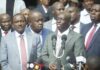
Opposition leaders have called for a full and speedy investigation into the death of former minister Cyrus Jirongo, demanding that those who were with him in the hours before his death publicly account for his final movements.
Led by Democracy for the Citizens Party (DCP) leader Rigathi Gachagua, the leaders addressed the media on Tuesday, December 16, after paying a condolence visit to Jirongo’s home in Nairobi. They urged National Assembly Speaker Moses Wetang’ula to clearly explain what transpired during a meeting he reportedly held with Jirongo shortly before his death.
Gachagua questioned what he described as an uneasy silence from individuals who were last seen with the former minister on the night he died.
“Kenyans are asking very simple questions: who were the last people to be with Cyrus Jirongo, and why are they quiet?” Gachagua said. “Speaker Wetang’ula should have given a very clear account of what his plans were and where he was going after that meeting.”
The opposition leader went further to draw parallels between Jirongo’s death and the 1975 killing of former Nyandarua North MP J.M. Kariuki a case widely regarded as a political assassination that has never been conclusively resolved.
“Kariuki died in the presence of people who knew him well, yet the truth was buried,” Gachagua said, suggesting that unanswered questions surrounding Jirongo’s death could fuel similar suspicions if not addressed openly.
However, those concerns were countered at the same briefing by former Westlands MP Fred Gumo, who is chairing Jirongo’s burial planning committee. Gumo said Speaker Wetang’ula had already given an account of his last interaction with the deceased.
According to Gumo, Wetang’ula visited Jirongo’s home on Sunday, December 14, and explained that he had met Jirongo in Karen on the evening of December 13. The Speaker reportedly left the meeting at around 9:30pm, leaving Jirongo in the company of two other friends, whose identities were not disclosed.
Gumo also announced that a post-mortem examination will be conducted on Wednesday, December 17, to establish the exact cause of Jirongo’s death.
Even so, opposition leaders insisted that investigations must be fast-tracked. They called on President William Ruto to direct the Directorate of Criminal Investigations (DCI) to move swiftly and provide clear answers to the public. They also demanded statements from passengers who were travelling in the bus that collided with Jirongo’s vehicle on the night of the crash.
Earlier on Monday, the DCI said preliminary investigations confirmed that the accident occurred on December 13 at Karai, along the Nairobi–Nakuru Highway. This came amid speculation on social media that the crash scene may have been interfered with.
Detectives said they are reviewing Jirongo’s movements in the hours before the accident, including recording statements from people he interacted with earlier that night. Among the areas of interest is a meeting held at Karen Oasis Bar and Restaurant in Nairobi.
As investigations continue, leaders across the political divide described Jirongo as a principled and outspoken figure who stood firmly by his beliefs. For now, his family, friends and supporters say they want one thing above all else the truth about how his life came to an abrupt end.