Kenya and the United States have agreed to begin formal negotiations on a reciprocal trade agreement, marking a new phase in bilateral economic relations as the African Growth and Opportunity Act (AGOA) approaches its September expiry.
The agreement followed high-level talks in Washington this week led by Kenya’s Cabinet Secretary for Investments, Trade and Industry, Lee Kinyanjui, and US Trade Representative (USTR) Ambassador Jamieson Greer.
The discussions, which build on earlier engagements in March and May 2025, were described by both sides as “productive and forward-looking.”
“Kenya is deeply interested in the commencement of formal negotiations with the US government. A reciprocal trade agreement is crucial for securing long-term access to the US market for Kenyan products and will provide the stability needed to unlock new investments,” CS Kinyanjui said.
He noted that several US companies have already expressed interest in expanding their operations in Kenya, with the new framework expected to provide an enabling environment for growth.
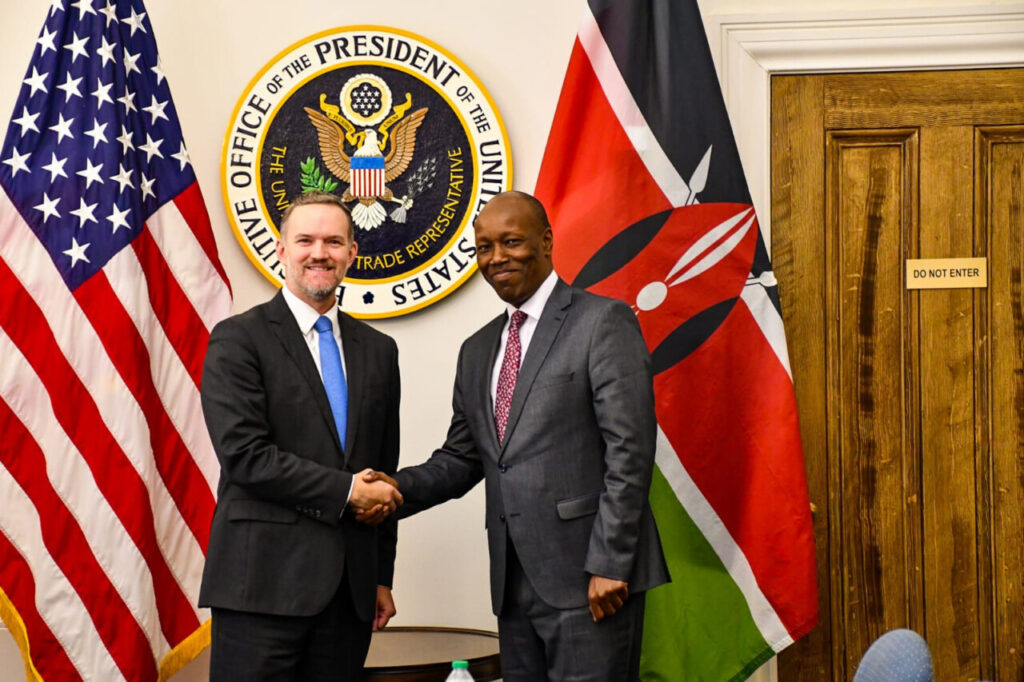
Ambassador Greer praised Kenya’s proactive stance and emphasized the US’s readiness to forge a pact that aligns with both countries’ priorities.
“Let’s build a partnership that leverages the growth of the manufacturing sector in America while providing a market for Kenyan products which cannot be sourced locally,” Greer said.
Kenya exported goods worth about $1.5 billion (Sh193.8 billion) to the US in 2024, making the US one of its top trading partners.
The Ministry of Investments, Trade and Industry believes transitioning from AGOA to a reciprocal arrangement will broaden trade relations by unlocking new sectors and investment opportunities, particularly in textiles, agriculture, and technology.
The talks come amid heightened protectionism under President Donald Trump’s administration. In April 2025, Trump announced tariffs of up to 125 per cent on imports from countries deemed to have unbalanced trade practices.
Although the tariffs were later scaled back to 10 per cent for 90 days to allow negotiations, they underscored Washington’s push for more balanced trade relationships.