Cabinet Secretary for Agriculture and Livestock Development, Mutahi Kagwe, has issued firm directives to protect Kenya’s macadamia sector amid escalating pest-related losses.
Macadamia Association of Kenya Chairperson, Jane Maigua, warned that harmful pesticides and increasingly aggressive pest infestations are destroying up to 40% of national production, resulting in annual economic losses estimated at KSh 2.88 billion.
Speaking during a high-level consultative meeting attended by Maigua, Pyrethrum Processing Company of Kenya Ltd acting CEO Njoroge Wachira, and Pest Control Products Board (PCPB) CEO Fredrick Muchiri, the CS was briefed on unprecedented crop losses driven by destructive pests whose spread has been accelerated by climate change.
These pests attack flowering nuts, bore into kernels, damage leaves, and trigger widespread premature nut drop.
Maigua reported that Kenya produces 45,000 MT of macadamia annually, with 44,100 MT deemed marketable. However, 17,640 MT are lost to insect damage each year—among them 2,222.64 MT of high-value export-grade kernels— translating into billions in lost revenue.
She added that processors also incur heavy electricity and labour costs as workers sort out insect-damaged nuts, increasing the financial strain on the industry.
According to the Kenya Plant Health Inspectorate Service (KEPHIS), stink bugs pose the greatest threat, followed by nut borers, lace bugs, moths, rats, and thrips.

Agriculture and Livestock Development CS Mutahi Kagwe.
- Stink bugs inject saliva into nuts, causing internal kernel damage and discoloration.
- Nut borers penetrate shells to feed on kernels.
- Lace bugs attack leaf undersides, leading to yellowing and premature leaf drop.
- Moths damage nuts before husks harden, causing early fruit drop.
- Rising temperatures have increased the prevalence of thrips, which damage flowers and reduce nut set.
- Rats continue to cause significant losses across plantations.
The PCPB outlined a legal emergency framework that allows rapid authorization of organic and pyrethrum-based pest control products.
The Board confirmed that once PPCK and KEPHIS identify the dominant pests, it can promptly approve emergency-use solutions, conduct local efficacy trials, set scientific application guidelines, and collaborate with counties to train farmers on proper product use to avoid export-threatening residue violations.
PCPB CEO Muchiri assured the CS that pyrethrum-based products would be fast-tracked once they meet efficacy and safety standards, emphasizing the need to reduce reliance on imported synthetic pesticides, which now exceed 20 million kilograms annually.
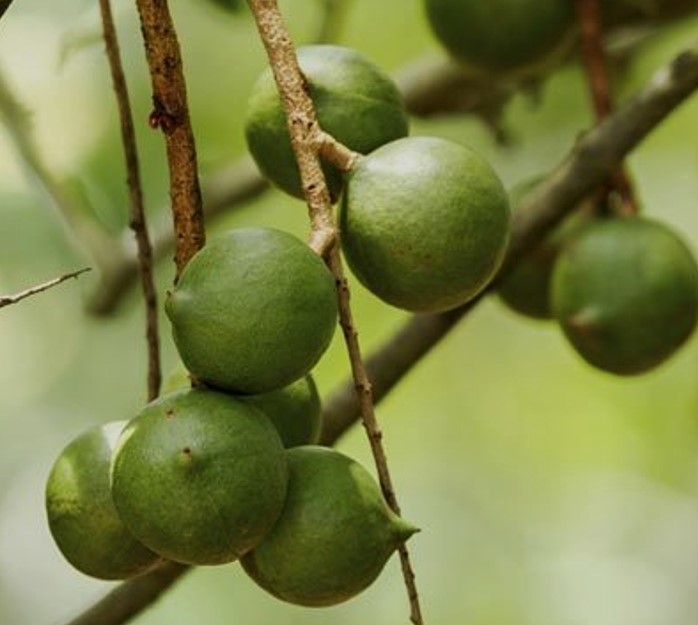
Unripe macadamia nuts.
CS Kagwe directed AFA Kenya, KEPHIS, PCPB, and county governments to intensify farmer awareness campaigns through radio and extension services, promote Integrated Pest Management (IPM), minimize dependence on imported chemical pesticides, and adopt safer, residue-compliant solutions to protect Kenya’s premium export markets.