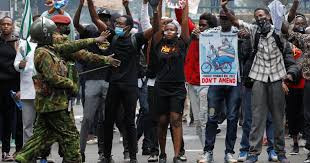
The High Court in Nairobi has awarded a Jomo Kenyatta University of Agriculture and Technology (JKUAT) student Ksh8 million in compensation after finding that police officers violated his constitutional rights during his arrest at the height of student protests in 2019.
In the judgment, the court held that the student’s rights were infringed when he was violently assaulted, unlawfully arrested and detained without justification by police officers responding to unrest near the university.
The court ordered that the compensation be paid by the Inspector General of the National Police Service and the Office of the Director of Public Prosecutions (ODPP).
“Petitioner is entitled to Ksh8 million for the violation of his rights, to be paid by the 1st and 2nd Defendants.” the judgment states.
As per court documents, the student was walking near the JKUAT campus in Juja in November 2019 when he was met by police officers who assaulted him without providing any reason behind the arrest and then arrested him.
Justice Patricia Nyaundi ruled that the officers’ actions amounted to a violation of the student’s constitutional rights, including the right to human dignity, security of the person and protection from cruel, inhuman and degrading treatment.
“A declaration hereby issues that the violent assault and subsequent arrest and detention of the Petitioner by the officers of the 1st respondent occasioned a violation of the right to human dignity, freedom from cruel, inhuman and degrading treatment contrary to Articles 28 and 29 of the Constitution of Kenya, 2010,” the judge ruled.
Further, it was noted by the court that the petitioner did not receive justice due to the improper handling of the case by state institutions.
Evidence presented during the proceedings showed that the assault had been captured on video, prompting investigations by oversight bodies that confirmed the incident and identified the police officers involved.
The court heard that although the ODPP found there was enough evidence to prosecute the officers, it instead opted for a diversion process—an alternative mechanism for resolving criminal matters outside the normal trial process. However, that process was never implemented.
According to Justice Nyaundi, the failure to complete the diversion process denied the petitioner justice and an effective remedy to the problem.
Court papers revealed the torture that the student underwent. The boy is alleged to have been tortured, kicked, tied up and put in a police car while he was tortured further on the way to the police station.
Though he was injured, he was held in degrading circumstances, not given prompt medical treatment, and then released without charging him or even booking him.
From the psychological and medical reports made available in court, it was evident that he was suffering from injuries as well as mental injuries such as PTSD.
This judgment comes in a period when calls for police accountability are rising in the nation with various human rights violations by security organs in their law enforcement and protest suppression activities.
Humanize