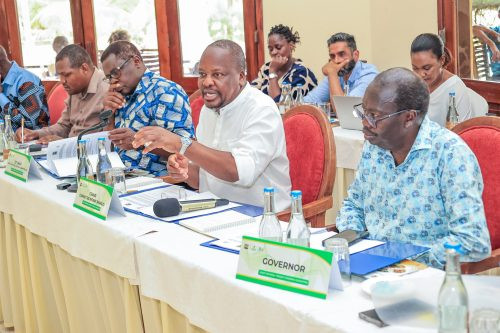
Kenya will not endorse donor-funded projects in agriculture that ignore the ground truth. This is the position of the Agriculture and Livestock CS, Mutahi Kagwe, who made the statement during a joint meeting with county and national governments and the World Bank at Mombasa.
Kagwe told the donors not to offer generic projects that do not fit the ground truth in Kenya. The country will only back projects it has co-created and aligns with the ground truth.
“Don’t tell us you’re funding us because you’re funding other countries,” he said during the meeting. “We are not the same. Our needs are different. We want to initiate and co-design these projects. If a project isn’t tailored for us, we will reject it.”
Kagwe said Kenya’s agriculture projects need to be designed and planned at the local level and align with the county and national development plans. The projects should not be poorly planned since this will mean they will not deliver and will also make it hard to hold anyone accountable for their failure.
Kagwe also told county governments to design their projects well and connect them to the national digital platforms such as KIAMIS and KADIC.
“Let us work together. Avoid duplication and plug into national systems,” he told county officials.
Kagwe noted that there are many donor-funded projects across Africa that are following the same playbook, yet the climate, soil, and culture are completely different in each country. In Kenya, the climate varies from the highlands to the arid areas, and the projects that are tailored to the local environment are the ones that are likely to succeed and last longer than the donors’ funds.
In the meeting, Kagwe also reminded the participants that the World Bank-funded programmes that are already underway, such as the National Agricultural Value Chain Development Project and the Food Systems Resilience Project, are implemented through loans amounting to KSh 49.5 billion.
“These are borrowed funds, they must deliver value for money,” Kagwe asserted, stating that the success of these programmes is critical to the country’s food security and stability.
He also noted that the country is spending over KSh 500 billion annually on food imports, and this is unsustainable and a threat to the country’s sovereignty.