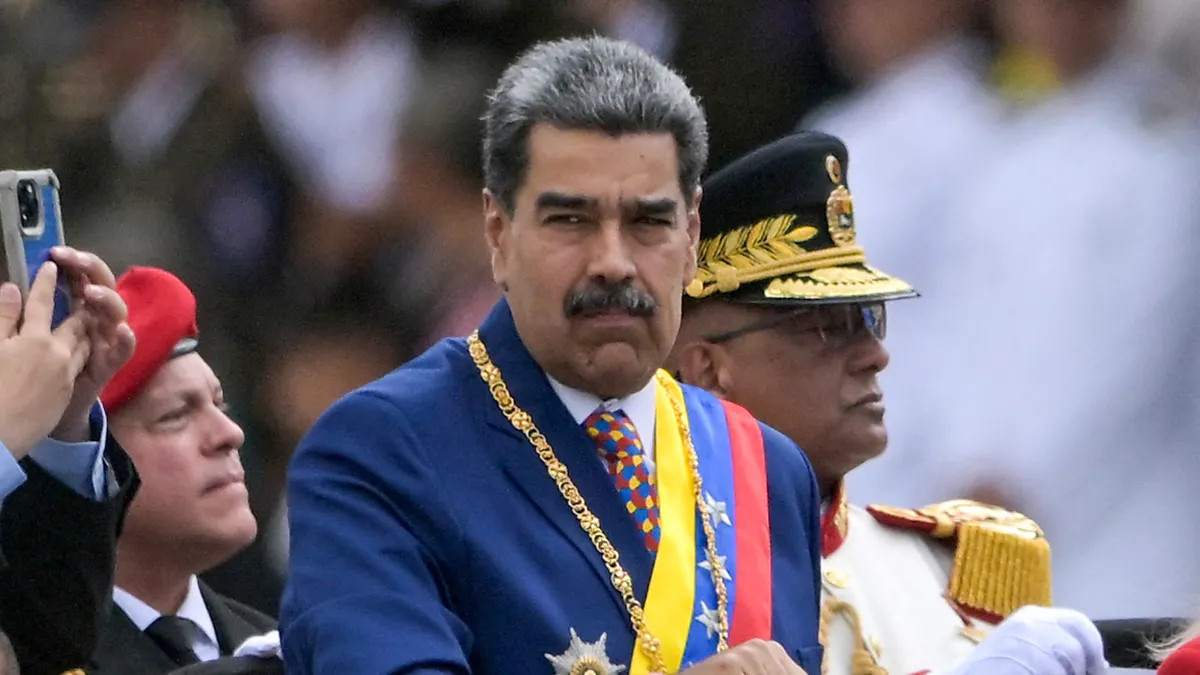
In a dramatic escalation of U.S. foreign policy in Latin America, Venezuelan President Nicolás Maduro and his wife, Cilia Flores, were captured by United States forces early Saturday in a highly controversial military operation in Caracas, Venezuela.
President Donald Trump confirmed the operation, asserting that Maduro and Flores are now in U.S. custody and face federal criminal charges in New York. Images and reports show Maduro blindfolded and aboard a U.S. Navy vessel after being flown out of Venezuela.
The operation involved air and military strikes on key targets in and around Caracas, including military bases, and was followed by a coordinated ground mission by U.S. special forces. Maduro and his wife were subsequently transported to the United States to answer indictments related to narcotics and weapons offenses.
U.S. Response and Trump’s Strategy
President Trump described the mission as a decisive blow against narco-terrorism and declared that the United States will oversee a transition in Venezuela. In remarks following the raid, Trump said the country will be “run” temporarily by U.S. authorities until a stable political transition can be arranged.
U.S. officials, including Secretary of State Marco Rubio, downplayed notions that the operation marked a full-scale invasion, emphasizing instead the targeted nature of the effort and its basis in long-standing criminal charges against Maduro.
Outrage and Legal Debate Internationally
The operation has sparked immediate international controversy. The United Nations and legal experts have questioned the legality of capturing a sitting head of state on foreign soil without authorization from Venezuela or the U.N. Security Council. Critics argue that the U.S. breached Venezuelan sovereignty and international norms.
Several governments, including France and Russia, condemned the action, calling it a violation of international law and urging Maduro’s release. Caracas also reported civilian casualties tied to the strikes, which Venezuelan officials estimate could be as high as 100 people.
Political Fallout in Venezuela
In the political vacuum left by Maduro’s removal, Venezuela’s Vice President Delcy Rodríguez declared herself interim leader, denouncing the U.S. operation and demanding proof of life for Maduro and Flores. Rodríguez’s move sets the stage for a bitter power struggle within Venezuela as the nation grapples with both domestic and international pressures.
What Happens Next?
Maduro is scheduled to be formally arraigned in a federal court in Manhattan on charges that include narcotics trafficking and related conspiracies. U.S. authorities assert these charges are part of long-standing legal efforts against his regime.
Meanwhile, nations and human rights groups are watching closely, debating the implications of this extraordinary intervention for regional stability and the future of international law.
As developments continue to unfold, this event stands as one of the most significant and contentious interventions by the United States in the Western Hemisphere in decades.
In a dramatic escalation of U.S. foreign policy in Latin America, Venezuelan President Nicolás Maduro and his wife, Cilia Flores, were captured by United States forces early Saturday in a highly controversial military operation in Caracas, Venezuela.
President Donald Trump confirmed the operation, asserting that Maduro and Flores are now in U.S. custody and face federal criminal charges in New York. Images and reports show Maduro blindfolded and aboard a U.S. Navy vessel after being flown out of Venezuela.
The operation involved air and military strikes on key targets in and around Caracas, including military bases, and was followed by a coordinated ground mission by U.S. special forces. Maduro and his wife were subsequently transported to the United States to answer indictments related to narcotics and weapons offenses.
U.S. Response and Trump’s Strategy
President Trump described the mission as a decisive blow against narco-terrorism and declared that the United States will oversee a transition in Venezuela. In remarks following the raid, Trump said the country will be “run” temporarily by U.S. authorities until a stable political transition can be arranged.
U.S. officials, including Secretary of State Marco Rubio, downplayed notions that the operation marked a full-scale invasion, emphasizing instead the targeted nature of the effort and its basis in long-standing criminal charges against Maduro.
Outrage and Legal Debate Internationally
The operation has sparked immediate international controversy. The United Nations and legal experts have questioned the legality of capturing a sitting head of state on foreign soil without authorization from Venezuela or the U.N. Security Council. Critics argue that the U.S. breached Venezuelan sovereignty and international norms.
Several governments, including France and Russia, condemned the action, calling it a violation of international law and urging Maduro’s release. Caracas also reported civilian casualties tied to the strikes, which Venezuelan officials estimate could be as high as 100 people.
Political Fallout in Venezuela
In the political vacuum left by Maduro’s removal, Venezuela’s Vice President Delcy Rodríguez declared herself interim leader, denouncing the U.S. operation and demanding proof of life for Maduro and Flores. Rodríguez’s move sets the stage for a bitter power struggle within Venezuela as the nation grapples with both domestic and international pressures.
What Happens Next?
Maduro is scheduled to be formally arraigned in a federal court in Manhattan on charges that include narcotics trafficking and related conspiracies. U.S. authorities assert these charges are part of long-standing legal efforts against his regime.
Meanwhile, nations and human rights groups are watching closely, debating the implications of this extraordinary intervention for regional stability and the future of international law.
As developments continue to unfold, this event stands as one of the most significant and contentious interventions by the United States in the Western Hemisphere in decades.