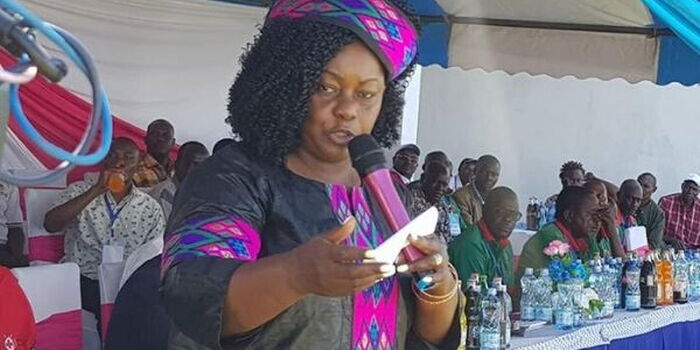
National Assembly Minority Whip Millie Odhiambo has come to the defense of the Odinga family following mounting criticism over the burial plans of Raila Odinga’s sister, Beryl Achieng Odinga.
A section of cultural purists has accused the family of going against Luo customs by planning to bury Beryl at her father’s Kango ka Jaramogi home instead of her marital home.
In a strongly worded statement shared on social media on December 5, 2025, Odhiambo who is also the Suba North MP challenged those insisting on strict adherence to tradition to examine their own cultural practices before lecturing others.
“All those who firmly opine that Beryl Odinga should be buried according to Luo customs, please confirm that your six lower teeth have been removed in strict conformity to Culture,” she wrote, taking a swipe at what she termed selective cultural enforcement.
Her remarks came days after Raila Odinga Jr announced on November 29 that the family had settled on Kango ka Jaramogi as the burial site for Beryl, who passed away on November 25, 2025.
A Life Marked by Triumph and Turbulence
Beryl Odinga’s life was one of both hardship and remarkable achievement.
Her marriage to former Gem MP Otieno Ambala who served briefly in 1974 has resurfaced in public debate, with some critics arguing that Luo traditions dictate she should be laid to rest at her husband’s homestead.
But family accounts over the years have painted the union as deeply troubled. In his 2014 autobiography Flames of Freedom, Raila Odinga described his sister’s marriage as abusive, recounting how Beryl eventually fled to Zimbabwe to escape the toxic relationship.
It was there, miles away from home, that Beryl carved out an extraordinary career milestone: becoming the first Black town clerk of Mutare, Zimbabwe’s third-largest city an achievement still remembered with admiration.
Ambala later died in 1985 while serving a prison term at Kodiaga Prison. He had been arrested in connection with the death of former Gem MP Horace Ongili Owiti, his political rival in the 1983 elections.
A Debate of Culture, Autonomy, and Dignity
The unfolding debate touches on broader questions around women’s autonomy, cultural expectations, and the right of families to chart their own path during moments of grief.
As preparations for Beryl’s burial continue, Millie Odhiambo’s defense underscores a growing sentiment among some leaders and Kenyans that culture should not be selectively weaponized especially in mourning.
For the Odinga family, the decision appears rooted not only in tradition but in the complicated personal history that defined Beryl’s life.