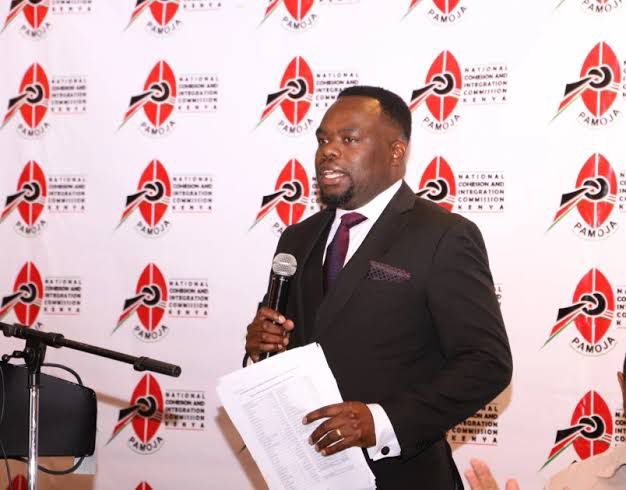
NCIC Commissioner Dr. Danvas Makori revealed that the loopholes in Kenya’s laws account for the continued impunity of politicians accused of hate speech.
Speaking to Radio Generation on Thursday morning in an interview, Dr. Makori pointed out the current legal definition of hate speech is extremely difficult to prove in court a mistake he says was purposeful from the start.
“Part of the 2008 National Accord deal following post-election violence was establishing this commission. But the law that created it was crafted weakly, and that was terribly intentional,” he said.
It is that the very high level of evidence which would be deemed as hate speech has been so hard to establish that it has become almost impossible to find perpetrators guilty even with irrefutable evidence of inciting statements.
“If you appear in court today and read the definition of hate speech, you will discover it is a very difficult thing to prove or obtain a conviction,” Makori claimed.
The commissioner declared that the NCIC had previously called on Parliament to revise the law, but this has been pending for over three years. He hinted that the delay may be intentional since some of the individuals who have a tendency to make provocative remarks are themselves MPs.
“They would not want us to hold them accountable, so it’s been a back-and-forth,” he went on.
Despite some politicians being invited in recent years over allegations of hate speech, none have ever been charged or convicted, which again indicates the deficiency in enforcement.
The law now defines hate speech as any act of using or disseminating words, materials, or conduct that are abusive, threatening, or insulting with intent or probable impact of provoking ethnic hatred.
Ethnic hatred in this case refers to hate of a race, national or ethnic group.
Its offenders are punishable by a fine not exceeding Ksh1 million, a jail term of up to three years, or both.
Even with the current law, Dr. Makori thinks that such penalties are still yet to be effective unless Parliament balances the law.
“We can call and warn people all we want,” he said to me. “But absent of having a stronger law, hate speech will just continue thriving, especially among politicians.”