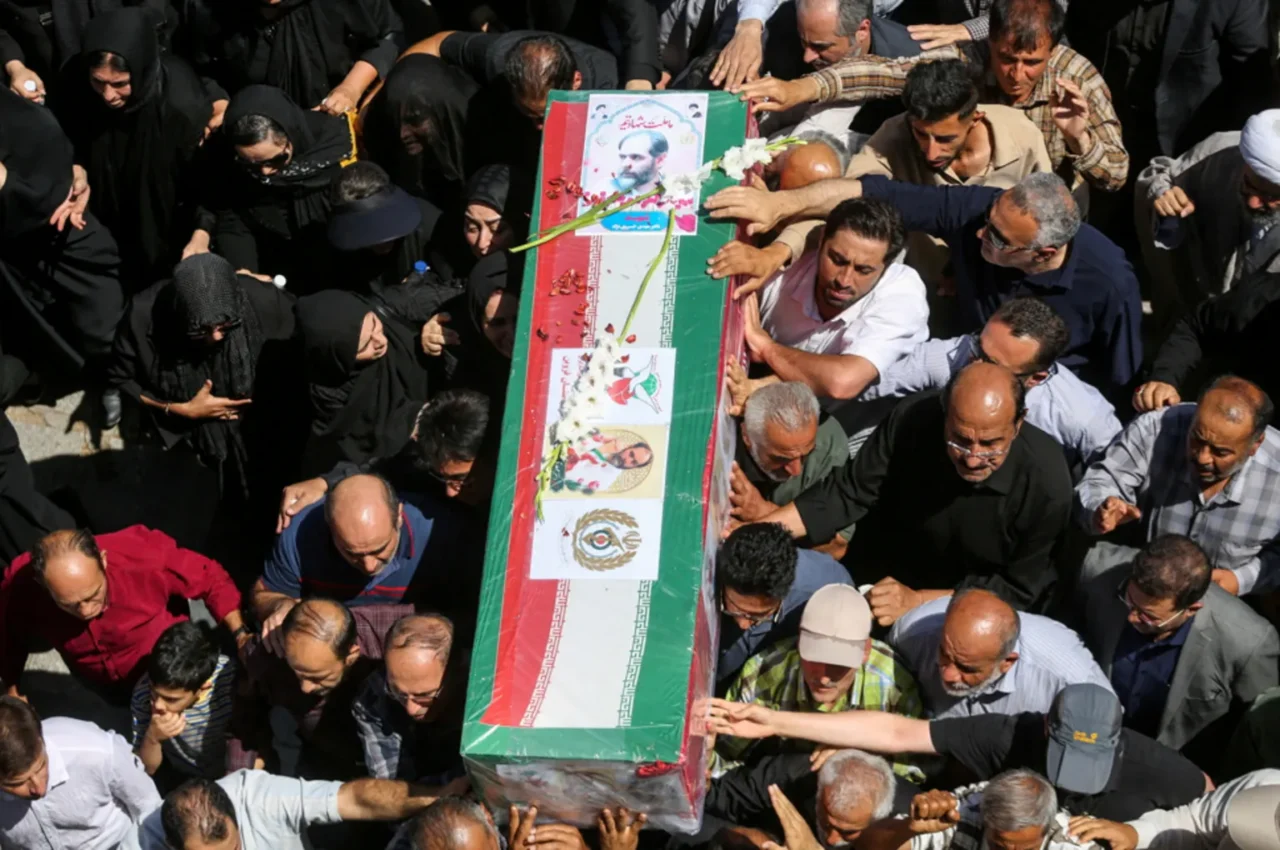
Iran held a solemn state funeral in Tehran on Saturday morning for over 60 people killed during the recent 12-day conflict with Israel. The funeral including high-ranking military commanders and prominent nuclear scientists.
The mass funeral, marked by scenes of national mourning, took place near Enghelab Square in the heart of the capital.
Families, friends and state officials raised flags, potrait of the deceased and coffins draped in the Iranian flag and all were surrounded by thousands of mourners clad in black, chanting anti-Israel and anti-US slogans.
Those who were buried includes General Mohammad Bagheri, Iran’s highest-ranking military officer and Chief of Staff of the Armed Forces.Other prominent figures laid to rest were Hossein Salami, commander-in-chief of the Islamic Revolutionary Guards Corps (IRGC), and nuclear scientist Mohammad Mehdi Tehranchi, who was also head of Azad University in Tehran.
The 12-day war saw unprecedented escalation after the United States became directly involved, launching airstrikes on several Iranian nuclear facilities. The strikes reportedly inflicted “excessive and serious” damage, as admitted by Iran’s Foreign Minister Abbas Araghchi.
U.S. President Donald Trump has further inflamed tensions with inflammatory remarks. Through his social media post, Trump declared he would absolutely consider bombing Iran again if intelligence revealed uranium enrichment at threatening levels.
In a separate post on his Truth Social platform, Trump mocked Iranian Supreme Leader Ayatollah Ali Khamenei, saying, “Why would the so-called ‘Supreme Leader’… say he won the war with Israel, when he knows his statement is a lie?” He also claimed he knew Khamenei’s hiding location during the conflict and implied that the U.S. spared his life. Araghchi condemned Trump’s tone, calling it “disrespectful and unacceptable.”
He urged the former U.S. president to act more diplomatically if he was truly interested in a future agreement with Iran.“The Great and Powerful Iranian People… do not take kindly to threats and insults.”
Araghchi wrote on X, reiterating Iran’s view that the conflict exposed Israeli vulnerability.With the region still on edge, the funerals served as both a tribute to Iran’s fallen and a renewed display of defiance against its adversaries.