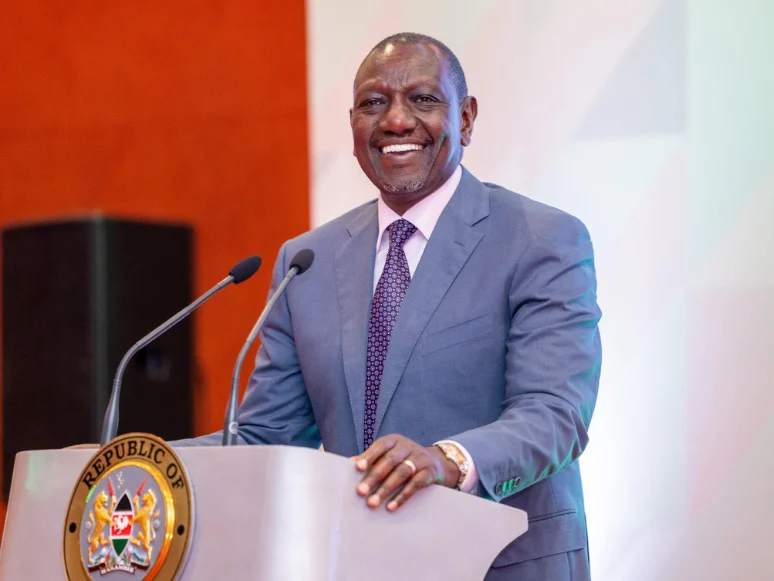
President William Ruto has highlighted key reforms in Kenya’s education sector, citing increased investment in school infrastructure, teacher recruitment, learner funding and the implementation of the Competency-Based Education (CBE) curriculum.
The President said the government had recruited 100,000 teachers over the past four years, with an additional 20,000 expected to be employed in December 2026 to address staffing shortages in schools.
He also announced plans to promote 50,000 teachers during the current financial year, supported by KSh4 billion allocated towards implementing new Career Progression Guidelines.
On school infrastructure, the government has constructed 23,000 classrooms and is delivering 1,600 laboratories for senior schools to improve learning facilities.
The administration also released more than KSh86 billion in school capitation before the opening of schools in 2026, while initiating the process of increasing the current KSh2,340 allocation per primary school learner.
Further proposals on the capitation increase are expected by January 2027.Under the CBE transition, the government facilitated the movement of 1.13 million pioneer learners to senior school in January 2026.
It has also initiated reforms to integrate primary and junior schools into comprehensive institutions with harmonised funding, staffing and governance structures.
In higher education, the government introduced a student-centred funding model for universities and Technical and Vocational Education and Training (TVET) institutions, directing financial support according to individual students’ needs.
The President further highlighted improvements in teachers’ welfare, including medical cover for 426,642 teachers and 887,358 dependants, with access to more than 4,000 health facilities nationwide and inpatient cover of up to KSh3 million.
Teachers have also been allocated 20 per cent of affordable housing units, while the PAYE exemption threshold has been raised from KSh24,000 to KSh32,000.
The government is also digitising learner records to eliminate ghost learners and schools, while targeting universal foundational literacy and numeracy by 2030.
President Ruto further revealed that engagement with teachers and their unions would continue, with the next Walimu na Rais forum scheduled for 2027.