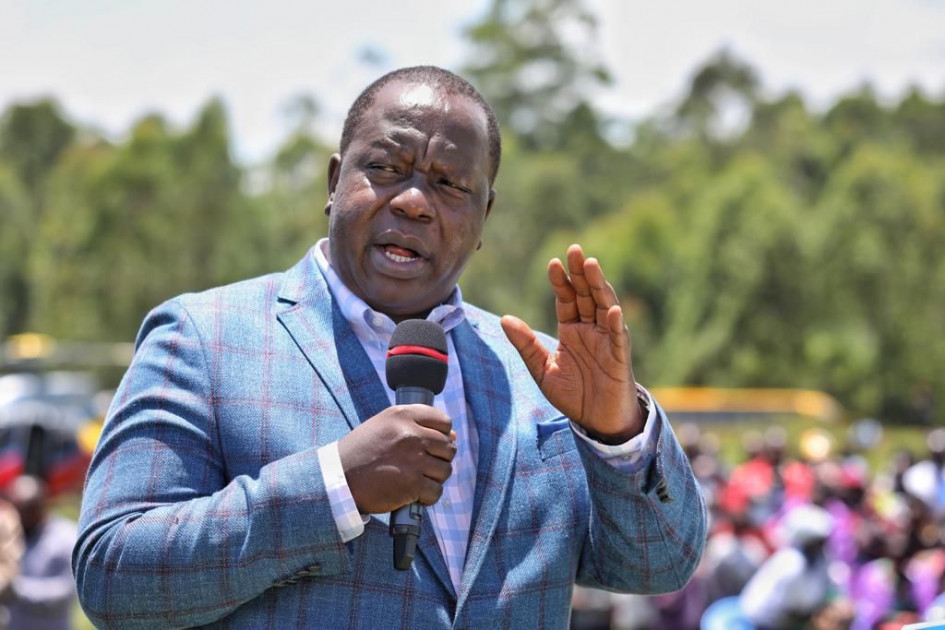
Jubilee Party Deputy Leader Fred Matiang’i has called for the full publication of Kenya’s Government-to-Government (G-to-G) oil importation agreement following fresh questions over the role of intermediaries in the petroleum supply chain.
Matiang’i said Kenyans should be allowed to examine the agreement and understand how the companies involved in supplying petroleum products were selected.
His remarks came after Ugandan President Yoweri Museveni said Uganda had previously been buying petroleum products through middlemen in Kenya instead of directly under the G-to-G arrangement.
Museveni later identified the Kenyan politician who alerted him to the issue as former senator Cyrus Jirongo, saying Jirongo had raised the matter with him in 2019.
In a statement, Matiang’i called for the agreement to be made public and the role of the intermediaries to be examined.
“The G2G agreement must be published in full. The role of the middlemen must be disclosed and scrutinized,” he said.
He also called for the National Oil Corporation of Kenya (NOCK) to be restored to what he described as its proper role in securing petroleum supplies and helping stabilise the local fuel market.
Matiang’i said the use of public resources required greater transparency.
“When public money is involved, secrecy cannot be the policy. Kenyans deserve to know who benefited, at what cost, and why,” he said.
Government defends oil import deal
The government has rejected suggestions of wrongdoing in the G-to-G arrangement, saying it was introduced to deal with a severe shortage of US dollars that had put pressure on fuel supplies and the country’s foreign exchange reserves.
Energy and Petroleum Cabinet Secretary Opiyo Wandayi said the arrangement was brokered in 2023 with three international oil companies Aramco Trading Fujairah FZE, Abu Dhabi National Oil Company (ADNOC) Global Trading Ltd and Emirates National Oil Company (ENOC).
According to Wandayi, the companies supplied refined petroleum products on 180-day credit terms.
He said the international oil companies then selected licensed Oil Marketing Companies (OMCs) to handle local supply logistics.
Gulf Energy, Galana Energies and Oryx Energies Kenya were initially selected, with One Petroleum, Asharami Synergy and BE Energy later added to the arrangement after further vetting.
Wandayi has maintained that the arrangement helped preserve Kenya’s foreign exchange reserves and ease pressure on the Kenya shilling against the US dollar.
The government’s explanation came after Museveni said Uganda had changed how it sourced petroleum products after discovering that intermediaries were involved in its previous procurement arrangement through Kenya.
The Ugandan president said the country subsequently moved to sourcing bulk petroleum products directly.
Museveni’s comments have since renewed debate in Kenya over how the G-to-G petroleum arrangement was structured and the role played by local oil marketing companies.
Matiang’i is now calling for the full agreement and details of the intermediaries involved to be made public for scrutiny.