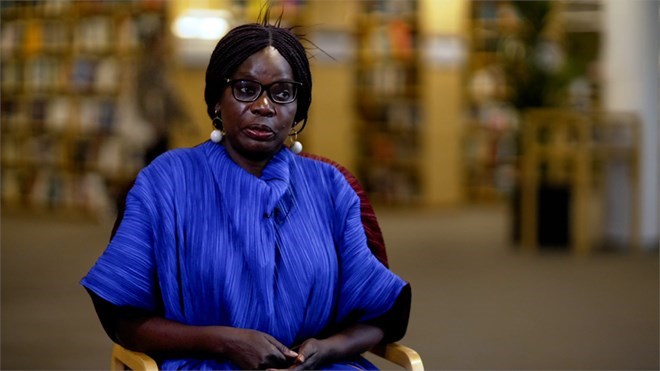
Kenyan legal scholar Prof Phoebe Okowa has secured a full nine-year term as a judge of the International Court of Justice (ICJ), extending her service on the United Nations’ highest court.
Okowa emerged victorious after a competitive election involving voting in both the UN General Assembly and the Security Council, eventually securing the seat in the third round after several candidates withdrew.
In the final ballot held at the UN headquarters in New York on Tuesday, November 3, she received 183 votes in the General Assembly, while her only remaining challenger, Peru’s Luz del Carmen Ibáñez Carranza, garnered two. Six countries abstained. The Kenyan scholar also secured the required absolute majority in the Security Council, overcoming an earlier setback in which she had received only six votes out of the 15-member body.
Okowa has been serving on the ICJ bench since last year, when she was elected to complete the term of Somali judge Abdulqawi Ahmed Yusuf, who resigned before his tenure was due to end in January 2027.
How did Phoebe Okowa win the ICJ election?
The contest developed into a battle between African candidates after the African Union failed to convince Okowa and Sierra Leonean jurist Charles Chernor Jalloh to withdraw from the race.
During the second round, Okowa secured 89 votes in the General Assembly, making her the only candidate to obtain an absolute majority at that stage. However, she failed to secure sufficient backing in the Security Council to be declared elected. Jalloh received 30 votes.
The election process requires candidates to obtain majority support in both the General Assembly and Security Council simultaneously. By then, four other candidates, Mahmoud Daifallah Hmoud of Jordan, Dapo Akande of the United Kingdom, Rena Lee of Singapore and François Alabrune of France, had already been elected after securing the required majorities in both UN bodies.
The organisation still needed one more judge to fill the five vacancies on the 15-member bench. Following the second round, Jalloh, South Korea’s Paik Jin-Hyun and Ecuador’s Marcelo Vázquez-Bermúdez withdrew, leaving Peru’s candidate as Okowa’s final challenger.
Nine candidates had initially contested the five positions, which were created by the departure of judges from Brazil, India, Kenya, France and Jordan. Okowa, 61, is an internationally recognised scholar of international law who has also served on the UN International Law Commission.
What does Okowa’s election mean for Kenya?
Although Kenya actively campaigned for her election, Okowa will serve as an independent judge rather than represent the country’s interests on the international bench. She may therefore preside over cases involving Kenya and is expected to make decisions guided by international law and her judicial responsibilities.
During the campaign, Kenya argued that her expertise would strengthen the court’s role in upholding international law and a rules-based global order.
“Our submissions urged the members of the UN present to reflect on the kind of Court our international community needs,” said Korir Sing’oei, Kenya’s Principal Secretary for Foreign Affairs, at the conclusion of the campaign in New York on Wednesday.
“The principles that must guide its composition, and the qualities required of those entrusted with interpreting and applying international law at this consequential moment in our shared history. Prof Okowa meets these demanding standards admirably, and we commended her candidature to all.”
The ICJ is the principal judicial organ of the United Nations and has 15 judges who primarily settle legal disputes between countries. It also provides advisory opinions on legal questions referred to it by authorised UN bodies, including the General Assembly. It is separate from the International Criminal Court (ICC), which prosecutes individuals accused of serious international crimes.