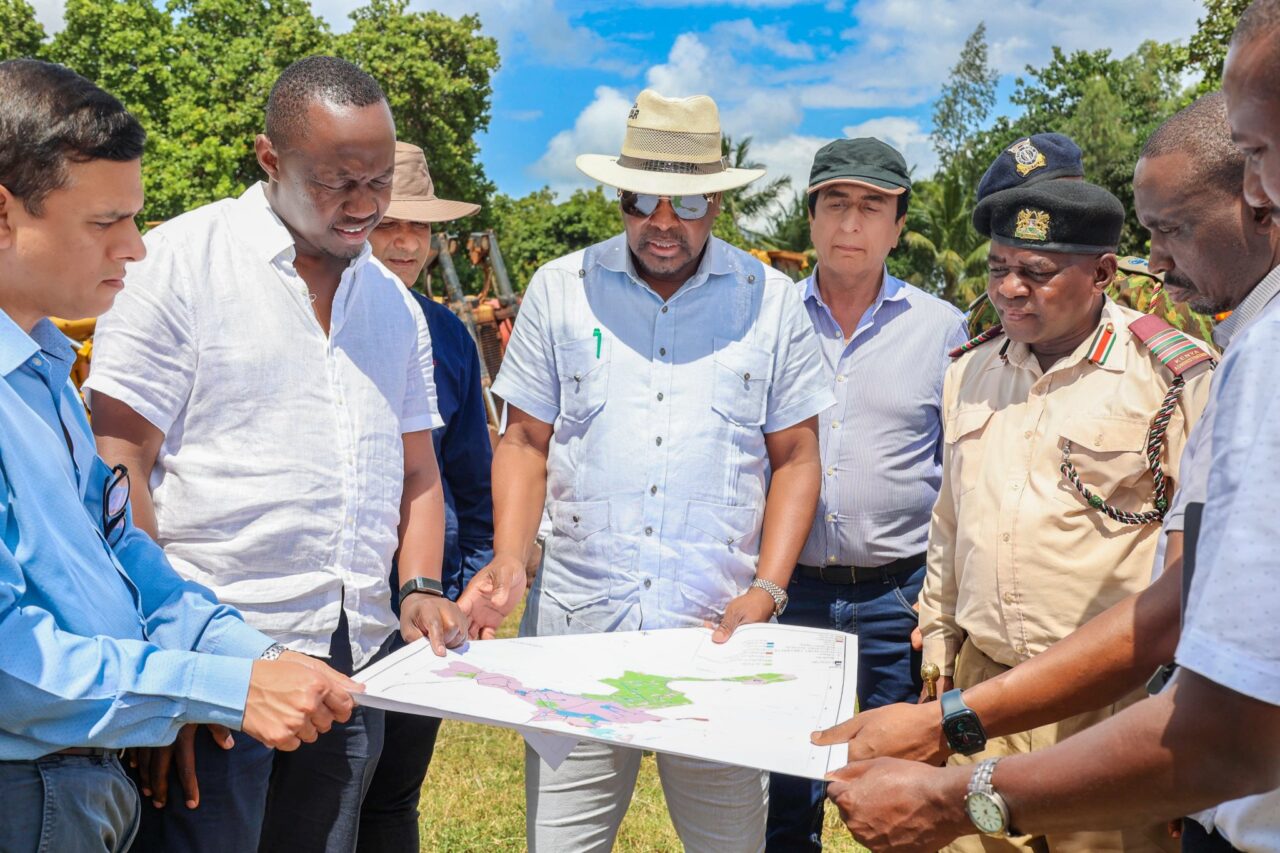
The Government has unveiled an ambitious plan to revive the troubled Kwale International Sugar Company Limited (KISCOL), a move aimed at restoring thousands of jobs, reviving sugarcane farming and stimulating economic growth across Kenya’s Coast region.
Agriculture Cabinet Secretary Sen. Mutahi Kagwe announced the formation of a high-level multi-stakeholder committee to oversee the factory’s revival after years of operational challenges that left farmers without a reliable market for their cane and stalled one of the country’s largest private sugar investments.
Speaking during an inspection tour of the factory, irrigation dams, plantations and outgrower farms, Kagwe said the Government’s focus was on rebuilding livelihoods rather than engaging in politics.
“This visit is not about politics. It is about the lives and livelihoods of the people of Kwale. A factory is only important because of the people whose lives it transforms,” he said.
The committee, to be led by the Kenya Sugar Board, will bring together the National Government, the Kwale County Government, investors, farmers, security agencies and local leaders to address the legal, operational and social challenges that have kept the mill closed.
Kagwe described KISCOL as one of Kenya’s most strategic sugar investments, citing its modern milling infrastructure, extensive irrigated nucleus estate and large network of outgrowers. He said the factory has the potential to transform the Coast region’s economy once operations resume.
Once operational at full capacity, the entire sugar factory is set to process thousands of tonnes of sugarcane each day thereby providing livelihood for thousands of people both directly and indirectly in activities such as farming, transportation, irrigation, mechanical works, inputs and retail trade and manufacture.
Apart from being a producer of sugar, the factory can facilitate value addition through molasses utilization, ethanol production and electricity generation from bagasse and hence open up additional economic opportunities in Kwale and other counties.
As per the statement by the Cabinet Secretary, the revival of KISCOL is not only expected to reduce the dependence on foreign sugar due to higher local production but will provide a steady market for cane to local farmers.
It should be noted that the difficulties facing the factory are not just financial, according to the statement by Kagwe. These include such problems as land conflicts, lack of cane, destruction of properties, late payment to farmers and insecurity.
As part of the interventions made, there is a plan to settle arrears of about KSh 66 million owed to the farmers. This is meant to ensure that the farmers have confidence in the factory and increase cane production.
He added that the residents should protect the sugarcane plantations and water supply systems, stressing that the destruction of the sugarcane plantations and the water supply system will just complicate the situation for the farmers and slow down the recovery process of the industry.
Moreover, the CS appealed to the government of Kwale County to move fast in resettling the 15,000 squatters who have occupied over 7,000 acres of factory land.
Drawing from the turnaround of leased public sugar factories in Western Kenya, Kagwe said collaboration between the Government, investors and local communities could similarly restore KISCOL to profitability.
“We have seen what can be accomplished through cooperation in other areas that grow sugarcane. Through collaboration between Government, investors, and communities, plants get reopened, production goes up and farmers start earning again. The same can be accomplished in Kwale County,” he said.
The team tasked with reviving the plant will put in place an outline showing the roles of all stakeholders while at the same time putting farmers at the heart of the process of revival.
According to Kagwe, Government involvement in the effort to revive KISCOL would be based on factors of transparency, accountability and a scientifically proven plan covering irrigation, cane cultivation, plant operation, finance, and sustainability.
On successful revival, KISCOL will provide an important economic base for the entire Coast region through its ability to revitalize agriculture, attract investment and create jobs for Kenyans while making the country more self-reliant in sugar production.