The Director of Public Prosecutions office has closed the last of the four Shakahola massacre cases, in which Paul Nthenge Mackenzie and 94 others were charged with 238 counts of manslaughter.
Chief Inspector Raphael Wanjohi told Chief Magistrate Alex Ithuku that Mackenzie and his co-accused shared a suicide pact, perpetrating the massacre with the pretext of meeting Jesus before the end of December 2020.
The 95th and last prosecution witness stated that Mackenzie instructed his followers to hasten their deaths through starvation in order to meet Jesus before his purported December arrival on Earth.
Wanjohi told the court that Mackenzie and 94 co-accused bore the greatest responsibility for the crime of manslaughter of 238 deceased persons.
The court further heard that those who resisted the pact fled the settlement.
The group had settled several kilometers deep inside the dense Shakahola forest, strategically away from authorities.
Mackenzie’s militia monitored movements and ensured strict compliance with the deadly fasting, the court further heard.
The settlement’s remoteness was 14 kilometers from schools, 35 kilometers from Lango Baya Police Station, and 32 kilometers from the nearest chief’s camp, hindering detection.
Inside the deep forest, away from the eyes of authority, Mackenzie and his close associates imposed his doomsday ideology on hundreds he had lured through indoctrination.
Call data analysis revealed systematic coordination between Mackenzie and his security team.
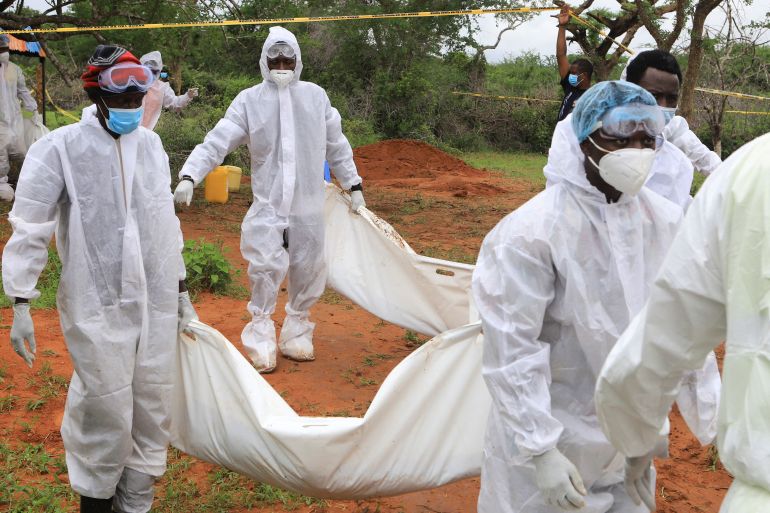
On the first day of exhumation operations, approximately 25 kilometers inside the forest, Wanjohi and his team uncovered 65 graves, including 14 containing multiple bodies.

Chief Inspector Raphael Wanjohi.
Each body was assigned a unique identifier, placed in labelled body bags, and transported to the subcounty hospital mortuary.
The mass graves, containing several bodies of male and female adults and minors, were shallow, with some bodies wrapped in bed sheets or lesos tied with knots before being buried, the court also heard.
The prosecutor told the court that some bodies were transferred from one grave to another, likely to avoid detection.
Starvation was the leading cause of death, followed by injuries, while some deaths remained undetermined due to decomposition.
DNA testing helped confirm identities and link victims to relatives.
Children and adults were often buried together, with graves flattened or concealed by crops.
Wanjohi explained that followers abandoned jobs, sold property, withdrew children from schools, and destroyed identity documents before relocating to Shakahola.
Mackenzie and his lieutenants developed a coded language to convey key messages to followers during the fasting period within Shakahola forest.
Among the coded language terms are “Wateule,” referring to members; “Mataifa,” to outsiders; “Harusi,” to burial; “Kunyakuliwa,” to rapture; and “Kanisa Jagwani,” to mean Shakahola.
This secrecy reinforced control and prevented outsiders from understanding internal operations.
Searches at Mackenzie’s premises recovered DVDs, religious books, files, and registers containing radical end-times teachings.