The government plans to expand Joint Operations Centres (JOCs) from the current eight to all 35 Border Management Committees (BMCs) to strengthen surveillance, intelligence sharing and coordination among agencies responsible for securing Kenya’s borders.
Speaking during the launch of the 12th Cohort of the Kenya Coordination Border Management Programme (KCBMP) on Monday at the Kenya School of Government, Pincipal Secretary for Internal Security and National Administration Dr Raymond Omollo said the expansion will improve monitoring of border activities, facilitate timely responses to emerging threats and enhance cooperation among government agencies.
He said the centres provide a common platform for gathering, analysing and sharing operational information.
The PS cited a recent cross-border anti-narcotics operation involving Kenyan and Tanzanian security agencies, which resulted in the recovery of 454 kilogrammes of suspected narcotics valued at KSh3.6 billion in Msambweni, Kwale County.
“This underscores the importance of data and intelligence sharing and joint action against transnational criminals,” said Dr Omollo.
He also revealed that more than 760,000 travellers had been screened at Kenya’s points of entry and exit, highlighting the importance of coordinated operations involving security, immigration, customs and other agencies.
The PS warned that corruption, collusion and information leakage within institutions responsible for border security could compromise operations, calling for stronger governance and accountability.
He added that the existing centres would support the development of technology-driven border management systems, including the proposed National Fusion Centre and a secure border management system.
Secretary of the Border Management Secretariat Kennedy Nyaiyo said the government was committed to establishing JOCs across all 35 BMCs to strengthen coordination among agencies operating at the country’s entry and exit points.
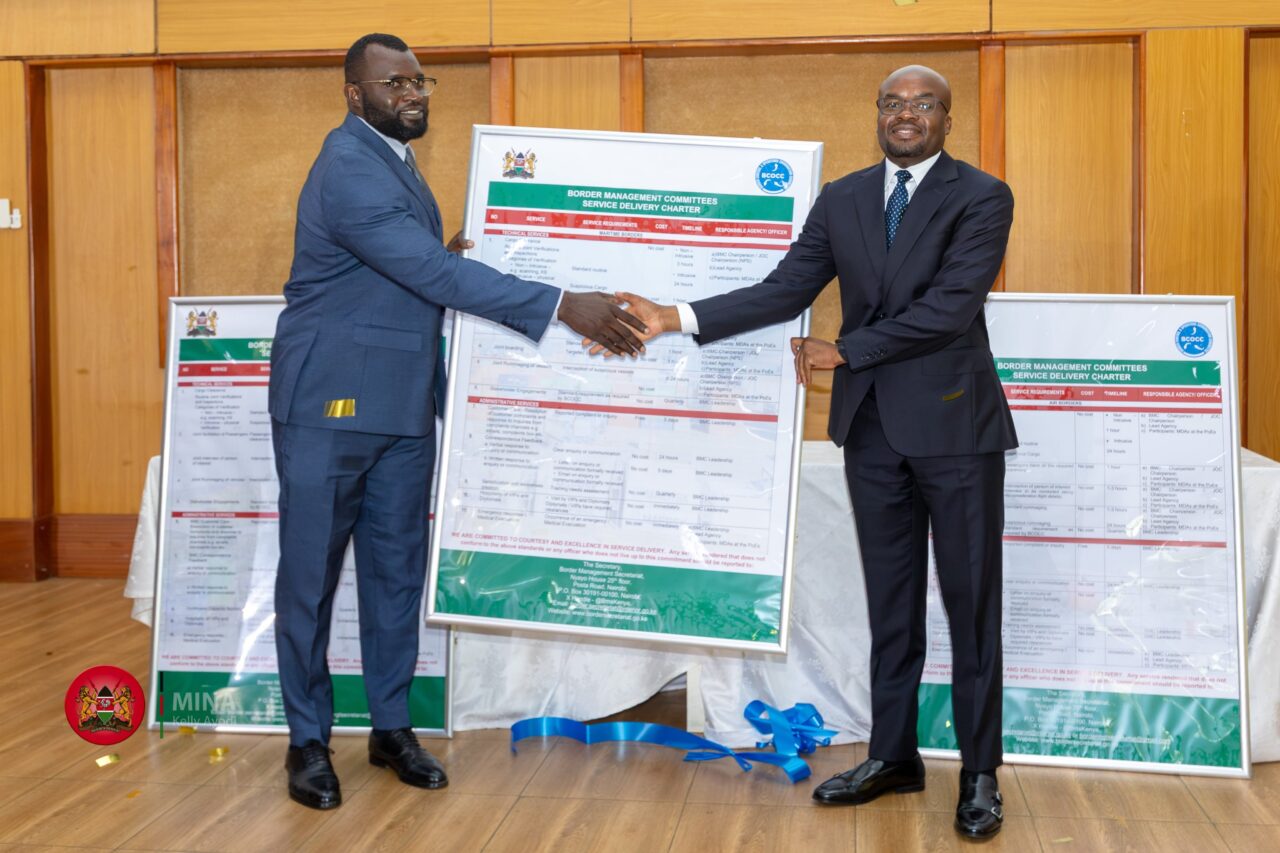
The three Joint Service Charters launched during the event cover Kenya’s land, air and maritime borders. They establish common service standards, outlining available services, application requirements, charges and expected processing times to improve transparency and accountability.
Under the charters, routine cargo clearance is expected to take approximately one hour, while passengers meeting all clearance requirements should be facilitated within a maximum of one hour. Processes requiring physical intervention may take up to 24 hours.
Air cargo processing is expected to take between one and three hours, while maritime procedures include joint consultations lasting between one and three hours and screening of suspicious vessels taking between six and 24 hours.
The 12th KCBMP cohort brings together 25 officers for training scheduled to run from November 9 to 20, following the training of 264 officers through the previous 11 cohorts.
The programme, developed through collaboration between the Border Management Secretariat and the Kenya School of Government, receives support from development partners, including the International Organization for Migration (IOM).
IOM Head of Operations for East and Southern Africa Jennifer Pro said effective border management depended on agencies sharing information and working together rather than operating independently.
Kenya has 35 designated points of entry and exit and shares land borders with Somalia, Ethiopia, South Sudan, Uganda and Tanzania.