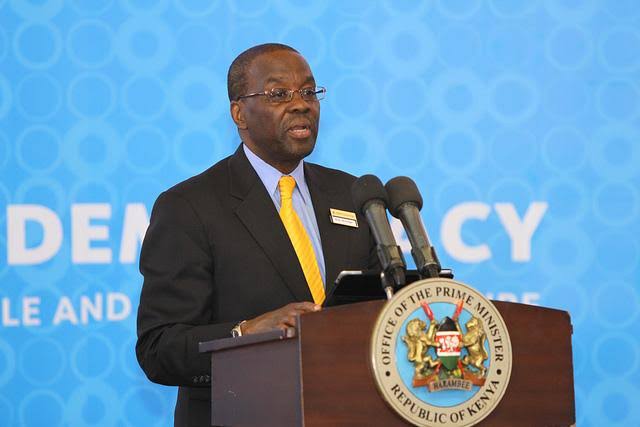
Former Chief Justice Willy Mutunga has warned Kenyan leaders against undermining the Constitution, saying the country’s progressive legal framework cannot deliver its promises if those in power are unwilling to implement it.
Speaking at the Global Trust Summit in Nairobi on Wednesday, October 21, Mutunga said the Constitution’s success depended on leaders and public institutions respecting its provisions and putting them into practice.
“Our Constitution is very progressive. But as long as those who are in power find it inconvenient, they are not willing to breathe life into it, and that includes institutions themselves,” Mutunga said.
The former Chief Justice’s remarks came as leaders, governance experts and civil society representatives gathered to discuss how to rebuild public trust in institutions and ensure democracy delivers beyond elections.
The summit focused on accountability, transparency, public participation and the need for leaders to turn promises into tangible results for citizens.
Mutunga’s warning placed the spotlight on the gap between constitutional principles and their implementation, particularly where institutions fail to uphold the values and responsibilities set out in the law.
Other speakers at the summit called for a shift from political messaging to practical reforms that address public concerns.
Dr Andrews, representing International IDEA at the event, said restoring public confidence required changes in processes, leadership and direction.
“It is not just about messaging; it’s also about change of process, change of people and change of direction,” Andrews said.
Transparency International Kenya Executive Director Sheila Masinde said access to information was essential in holding public institutions accountable.
She argued that citizens should not have to resort to court action to obtain information that public bodies should provide proactively.
“We don’t have to go to court if access to information is given more proactively,” Masinde said.
She added that citizens expected leaders to fulfil the mandates entrusted to them through elections.
“When I vote for you, I trust that you will deliver in the mandate you are seeking,” she said.
Mzalendo Trust Executive Director Caroline Gaita also challenged leaders to make public participation meaningful, warning that inviting citizens to meetings was not enough if their views were ignored.
“Participation without a feedback loop is not engagement; it’s attendance,” Gaita said.
The summit also heard calls for public participation to be inclusive and not dominated by the loudest voices.
Independent Policing Oversight Authority chair Duncan Ojwang’ said engagement should give all citizens a chance to contribute to decisions affecting them.
Meanwhile, IEBC chair Erastus Edung Ethekon said public distrust could create an opportunity for positive change and institutional transformation.
Murang’a Governor Irungu Kang’ata said trust had to be earned through action rather than claims.
“In terms of trust, you gain it by demonstrating, not by illustrating,” Kang’ata said.
The discussions centred on the need for public institutions to demonstrate accountability through measurable action, respond to citizens’ concerns and ensure that public resources serve the wider population.
The summit’s central message was that democracy should not end at the ballot box. Leaders and institutions must continue to demonstrate accountability, involve citizens in decision-making and deliver on the promises made to them.