Kenya’s population of people aged 60 and above is projected to more than double to 6.4 million by 2045, raising concerns over the country’s preparedness to support a rapidly ageing population.
Data from the Kenya National Bureau of Statistics (KNBS) show the number of older persons stood at about 2.9 million in 2024.
The figure is expected to rise to 3.4 million by 2030, 4.2 million by 2035 and 5.2 million by 2040 before reaching 6.4 million in 2045.
The projections have renewed calls for Kenya to rethink how it provides healthcare, income security, social protection and care for older citizens.
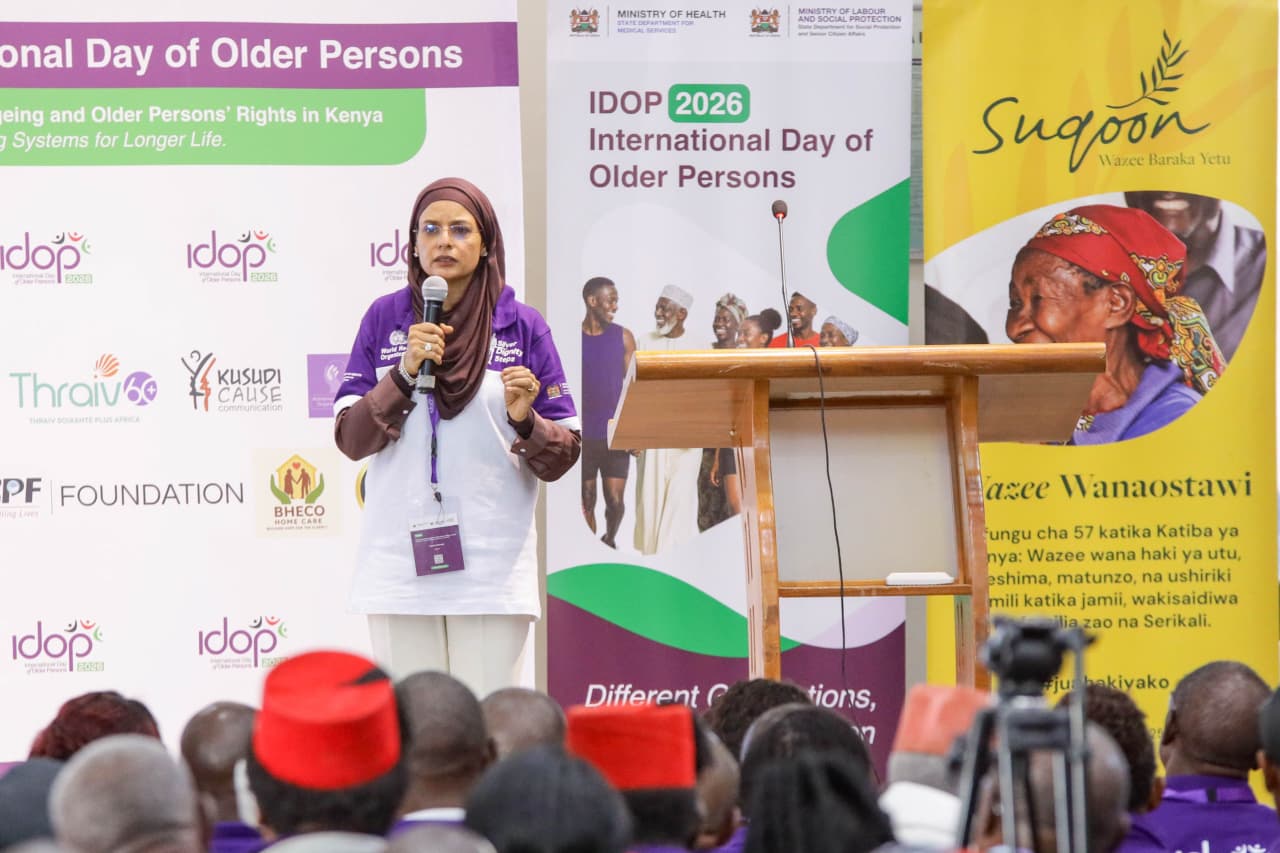
Speaking during the Fourth Kenya Social Protection Conference in Nairobi on September 29, Suqoon founder Shakira Khawaja said longer lives should be viewed as a success that requires stronger systems to support them.
“We worked hard for people to live longer. Now let us make sure our systems are ready for those longer lives, and that those lives are lived with function, contribution and dignity,” Khawaja said.
She warned that social protection should not only respond when older people have already lost their health, income or independence.
Khawaja said preventive measures could help reduce the pressure placed on families and the health system when older people become dependent on others.
She cited falls at home as an example, saying a simple accident could result in a fracture, hospitalisation, loss of mobility and eventually force a family member to stop working to provide care.
“That grab rail is not just a renovation. It is health protection. It is caregiver protection. It is social protection,” she said.
The growing elderly population comes as Kenya continues to expand its social protection programmes.
The government currently supports about 1.7 million households through various cash transfer programmes covering older persons, orphans and vulnerable children, persons with severe disabilities and households affected by drought.
President William Ruto also committed during the conference to establishing and capitalising a Social Protection Fund and expanding social protection coverage to 2.5 million households.
However, Khawaja called for greater attention to Kenyans between the ages of 60 and 69.
She noted that while the Constitution recognises a Kenyan aged 60 and above as an older person, the Older Persons Cash Transfer programme has traditionally targeted those aged 70 and above.
She called for a clear pathway to close what she described as a protection gap affecting this age group.
Khawaja also urged Parliament to take up the Older Persons Bill, 2024, which seeks to strengthen the legal framework for protecting the rights and welfare of older persons.
The debate comes as experts warn that Kenya’s ageing population will have implications beyond social assistance.
The 2019 census found that 84 per cent of older persons lived in rural areas, meaning healthcare and social protection services will also have to reach communities outside major urban centres.
Experts have also warned that the country will need more support for chronic disease management, rehabilitation, mental health, dementia care and long-term and home-based care as the number of older people rises.
Khawaja urged policymakers to also recognise the contribution of older Kenyans, many of whom continue farming, running businesses, raising grandchildren and supporting community networks.
“An elder is not where the life cycle closes. She is where it turns,” she said.
The Fourth Kenya Social Protection Conference, held at the Kenya School of Government in Kabete from September 29 to October 1, brought together policymakers, researchers, development partners, civil society, private sector representatives and beneficiaries to examine Kenya’s social protection system and its future.
With the number of older Kenyans expected to reach 6.4 million within two decades, experts say preparations will need to begin now rather than waiting for the demographic shift to fully take shape.