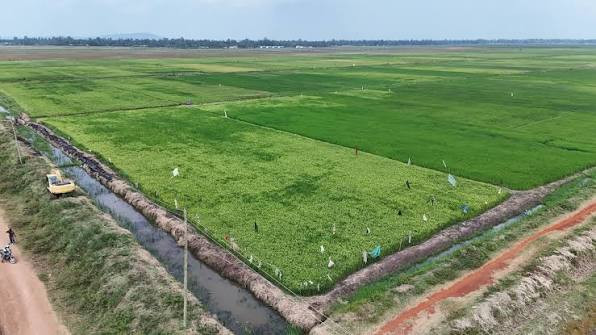
The government’s efforts to reduce Kenya’s reliance on imported rice have received a major boost, with the expansion of the Bunyala Irrigation Scheme now 62 per cent complete.
The project, which is being implemented under the Bottom-up Economic Transformation Agenda (BETA), is expected to bring more land under irrigation, increase rice production and improve food security at a time when the country continues to grapple with rising demand for the staple food.
Located within the Nzoia Irrigation Project that spans parts of Busia and Siaya counties, the Bunyala scheme has become one of the government’s flagship agricultural projects aimed at reducing dependence on rain-fed farming, whose productivity has increasingly been affected by unpredictable weather patterns linked to climate change.
In a statement issued on Monday, Principal Secretary Raymond Omollo said construction works have reached 62 per cent completion, bringing the project closer to delivering additional irrigated land for thousands of farmers in the region.
After completion, the project is bound to result in an increase in the yield of rice as well as improve the capability of the nation to satisfy the increasing demands within through locally produced rice.
For long, Kenya has been experiencing difficulties producing sufficient amounts of rice to meet the needs of its population hence compelling the nation to be importing rice in large numbers annually.
From trade statistics by the World Bank, it was evident that Kenya imported rice valued at over $500 million, equivalent to Ksh 65 billion, in just one year, 2024, with most of the commodity coming from Pakistan, India and Tanzania.
The high cost of imports has therefore obliged the government to invest in mega irrigation projects such as Bunyala, Mwea and Ahero.
One notable aspect about the Bunyala irrigation project is the change from the costly pump fed irrigation to the gravity fed irrigation which will get water from the River Nzoia.
This will greatly reduce the cost of irrigation, increase efficiency and ensure farmers receive a steady water supply throughout the year for increased production even when the rains fail.
It has also invested in post-harvest infrastructure through farmer-owned facilities to aid in preserving the harvested rice and ensuring easy access of the product to market in Kenya and other East African regions.
Apart from encouraging agricultural production, the project has also gathered a number of government departments to implement this project.
These include the State Department for Internal Security and National Administration whose roles include mobilization of communities, stakeholder management, land acquisition, land survey and security during construction of the project.
Founded in 1969 as a 540 acre pilot irrigation project, the Bunyala Irrigation Scheme has expanded over time to over 3,200 acres and employs over 14,000 farmers.
Rice is still the dominant crop grown in this irrigation scheme, with a total production of 10,000 metric tonnes per year of different varieties of rice such as Kwamboka, Super Rice, Gold and IR.
With the ongoing expansion expected to bring even more land under irrigation, the government hopes the project will increase farmers’ incomes, reduce Kenya’s import bill and strengthen the country’s long-term food security by producing more rice locally.