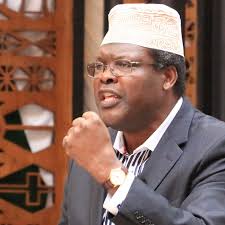
Lawyer and political commentator Miguna Miguna has entered the ongoing debate surrounding leadership and control within the Orange Democratic Movement (ODM), firmly dismissing claims that the party should be influenced by the family of the late Raila Odinga.
Miguna argued that ODM, like all political parties in Kenya, is a public institution sustained through taxpayer funding and contributions from its members, and therefore cannot be treated as private property in a statement released on social media.
“ODM is not a private or family entity. It is a public institution funded through the Political Parties Fund and by members,” he said.
He pushed back against suggestions that members of Raila’s family, including his widow, siblings or children, should have any special role or influence in the party’s affairs following his death.
According to Miguna, such arguments risk undermining democratic principles and reviving a culture where political parties revolve around individuals rather than institutions.
“ODM was not Raila Odinga’s personal property, and his family cannot claim special privileges or control over its direction,” he added.
Miguna’s remarks come at a time when ODM is grappling with internal tensions, with public exchanges between senior leaders and members of the Odinga family exposing cracks within the party.
Recent statements by Raila’s son, Raila Odinga Junior, called for respect toward the family amid emerging factional disputes, while a separate exchange involving Treasury Cabinet Secretary John Mbadi and EALA MP Winnie Odinga has further highlighted divisions within the party.
The debate has now shifted to the broader question of succession and control within ODM, a party that for years has been closely associated with Raila Odinga’s leadership.
The controversy underscores the challenges facing ODM as it navigates a transition period following the loss of its long-time leader, with competing voices now shaping the conversation on the party’s future.
Miguna’s intervention adds a sharp institutional perspective to the debate, raising questions about whether Kenyan political parties can evolve beyond personality-driven structures into fully democratic entities.
The unfolding exchanges are likely to shape the direction of ODM in the coming months, especially as the country gradually begins positioning itself for the 2027 General Election.