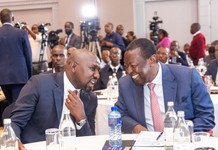
Kenya’s electoral body this week hosted a high-profile delegation from Zambia as Lusaka seeks to sharpen its systems in the face of crucial general elections scheduled for August 2026.
The delegation to the Electoral Commission of Zambia, led by Commissioner Ndiyoi Mutiti, arrived in Nairobi for a peer-learning and benchmarking visit to the Independent Electoral and Boundaries Commission. Their objective is modest yet profound: to study how Kenya runs its elections-what has worked, what has failed, and how those lessons can help Zambia deliver a more credible, more inclusive vote next year.
Inside IEBC’s offices, the Zambian officials had a thorough discussion with their Kenyan counterparts on everything from voter registration to election-day technology, the management of disputes. The visit is an important development for Zambia which amended its constitution recently and introduced a new model of election called Mixed Member Proportional Representation (MMPR).
Under this arrangement, Zambia will retain the familiar First-Past-the-Post method of electing its leaders but will add to this the proportional representation system to more conclusively usher in more women, youth and persons with disabilities into Parliament and local councils. The ECZ hopes that learning from Kenya’s experience will help them avoid pitfalls as they roll out the new system.
Technology has been a big focus of the tour. Kenya’s IEBC relies on KIEMS-a set of multifunctional tablets used to identify voters through fingerprints and facial recognition at polling stations. To make them tamperproof, the devices are password-protected at a device level, while transmitted information is protected by digital signatures and encrypted storage.
In 2025, the IEBC even upgraded the kits to include iris recognition, making Kenya one of the more technologically advanced election managers on the continent. Supplied by the Venezuelan firm Smartmatic, the kits come with power banks and chargers to keep them running in remote areas, and the commission says about 99 per cent of them are fully functional.
By contrast, Zambia still relies mostly on fingerprints and photographs to register citizens biometrically and has not deployed similar verification kits on election day. It has introduced mobile registration, but lacks matching systems to automatically flag deceased voters or detect new ones gaps that featured prominent in the benchmarking talks.
Precisely because of these differences, however, the visit matters for the Zambian delegation: by seeing Kenya’s systems up close, they hope to adapt what works and avoid costly mistakes as they modernise their own processes.
IEBC officials said that indeed was a mutual exchange, allowing both sides an experience-sharing opportunity on how to manage elections in such a delicate political environment. The lessons picked up in Nairobi, as it were, could make the difference come August 2026 for how millions of its citizens mark their ballots and how confidently they trust the results.