Slack has announced a major expansion of its platform to enable developers and enterprises to build secure, context-aware AI applications directly on its collaboration network, positioning itself at the center of the “agentic era” of work.
The new tools — a real-time search (RTS) API and a Model Context Protocol (MCP) server — provide developers with secure, flexible access to the vast troves of conversational data within Slack.
The move allows partners to create intelligent, context-driven AI agents capable of understanding and acting on workplace discussions without compromising privacy or governance standards.
Leading technology innovators — including Anthropic, Google, Perplexity, Writer, Dropbox, Notion, Cognition Labs, Vercel, and Cursor — are already developing new AI-powered Slack apps using the capabilities, now available in the Slack Marketplace.
“The future of work is undeniably agentic, and the success of AI depends on its seamless integration into human workflows,” said Denise Dresser, CEO of Slack. “These innovations create the secure, data-rich environment necessary for AI agents to become trusted companions in everyday work.”Unlocking Conversational Context for Smarter AI
Slack’s new RTS API gives apps and agents real-time, permission-based access to messages, files, and discussions, allowing AI systems to retrieve relevant information without downloading or storing data externally.
The MCP server standardises how large language models (LLMs) and AI tools access and execute tasks across Slack, simplifying development and ensuring consistent, secure connections.
By grounding AI agents in real-time conversational context, Slack aims to eliminate “hallucinations” and deliver more relevant, actionable responses — enabling faster decisions, smarter automation, and better collaboration.
Addressing App Overload
Slack is also positioning itself as a remedy for app fatigue in large enterprises. With companies juggling over a thousand applications, context-switching has been shown to cut productivity by up to 40%.
Slack’s approach brings AI-powered tools directly into the flow of work, helping users act on data, complete tasks, or generate reports through natural conversation — without leaving their workspace.
New developer features such as Slack Work Objects, Block Kit Tables, and Agentic Developer Tools aim to streamline the creation of AI-driven experiences, from CRM updates to workflow automation.
Partner Innovations
Partners are already leveraging the new features:
- Anthropic’s Claude integrates with Slack to draw on team discussions for contextually grounded insights.
- Google Agentspace connects Slack data with productivity tools for seamless information flow.
- Dropbox Dash uses the RTS API for secure, real-time document access.
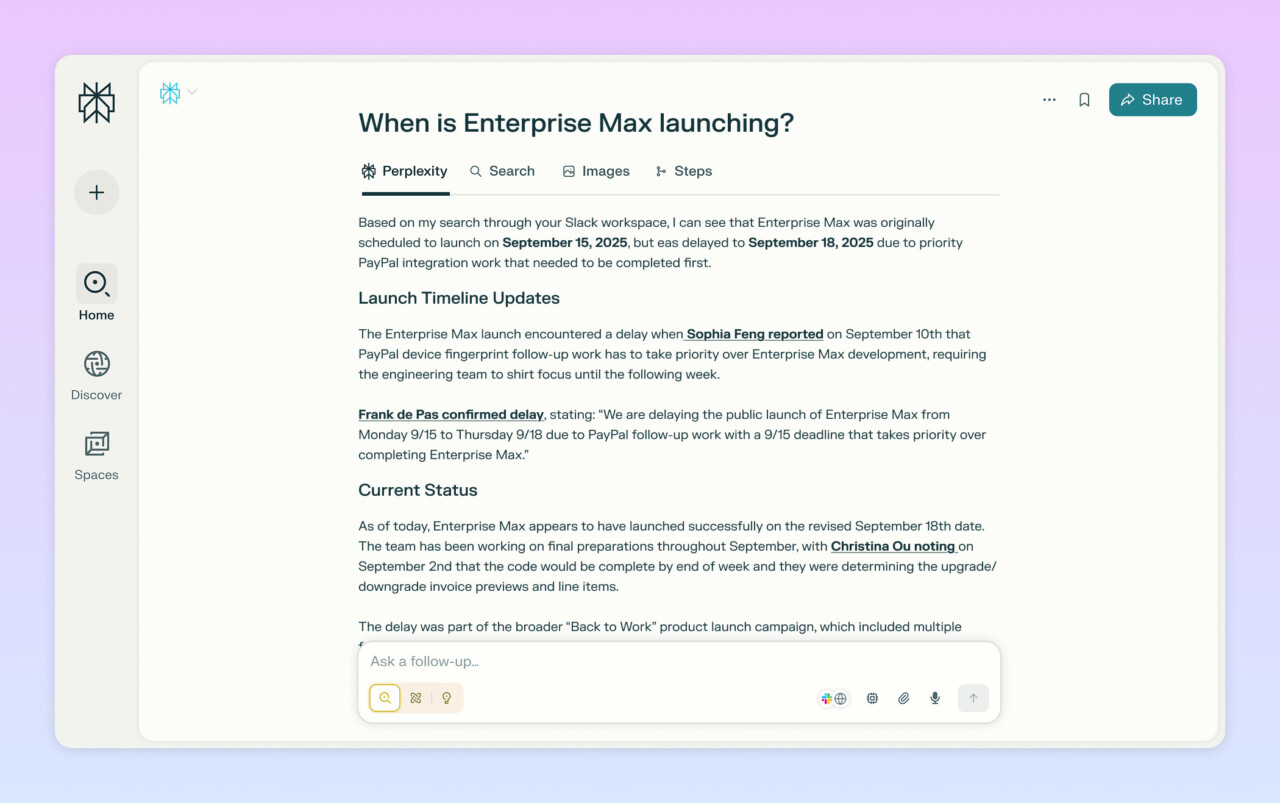
- Perplexity Enterprise merges web search with Slack conversations to deliver contextual answers.
- Notion AI enables users to query Slack conversations directly from Notion.
Rollout Timeline
The RTS API and MCP server are currently in closed beta, with general availability slated for early 2026. Slack Work Objects will roll out to all developers by late October 2025, while the new developer tools are available immediately.
By transforming conversational data into actionable intelligence, Slack is betting that the next frontier of workplace productivity lies not in more apps — but in smarter, more contextual collaboration.