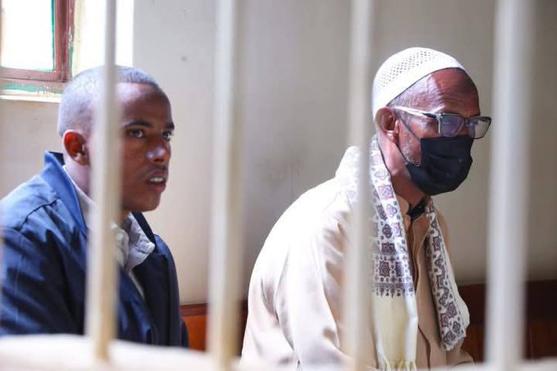
A Kenyan anti-terror court has sentenced two men to 30 years in prison each for their involvement in the 2019 DusitD2 terror attack in Nairobi, which claimed 21 lives and left many others injured.
The ruling was delivered on Thursday at the Kahawa Anti-Terror Court by Lady Justice Diana Kavedza, who found the accused Mohamed Abdi Ali, 61, and Hussein Mohamed Abdille Ali, 22 guilty of facilitating and conspiring to commit a terrorist act.
Mohamed Abdi Ali, a madrassa teacher, was convicted on 14 counts of facilitating a terrorist act and one count of conspiracy. He received 15 years for each facilitation charge, to run concurrently, and an additional 15 years for conspiracy, totalling 30 years in prison.
His co-accused, Hussein Mohamed Abdille Ali, was sentenced to 15 years for conspiracy and 15 years for facilitating a terrorist act. Unlike his co-accused, the court ruled that Hussein’s sentences will run consecutively, also amounting to a 30-year term.
The two were found to have played crucial roles in enabling the January 15, 2019, attack on the DusitD2 Hotel and business complex in Nairobi’s Riverside Drive, where Al-Shabaab militants stormed the premises in a coordinated assault that targeted innocent civilians, including foreign nationals.
Justice Kavedza stated that the prosecution, which presented evidence from 45 witnesses, had proven its case beyond reasonable doubt. She termed the attack as “devastating and traumatic,” citing not only the physical and emotional toll on survivors but also the lasting grief of bereaved families.
Victim impact statements presented in court underscored the deep emotional scars left by the attack. Among them was Joseph Spindler, father of American victim Jason Spindler, who told the court, “Jason was a survivor, a doer, and a visionary. He deserved a future, not a grave marked by the shrapnel from a terrorist’s suicide vest.”
The court also heard of another survivor who continues to suffer from serious health complications due to bullets still lodged in his body, alongside overwhelming medical bills.
The landmark judgment sends a strong message that Kenya’s judiciary remains committed to holding accountable all individuals involved in acts of terrorism, whether through direct action or indirect facilitation.