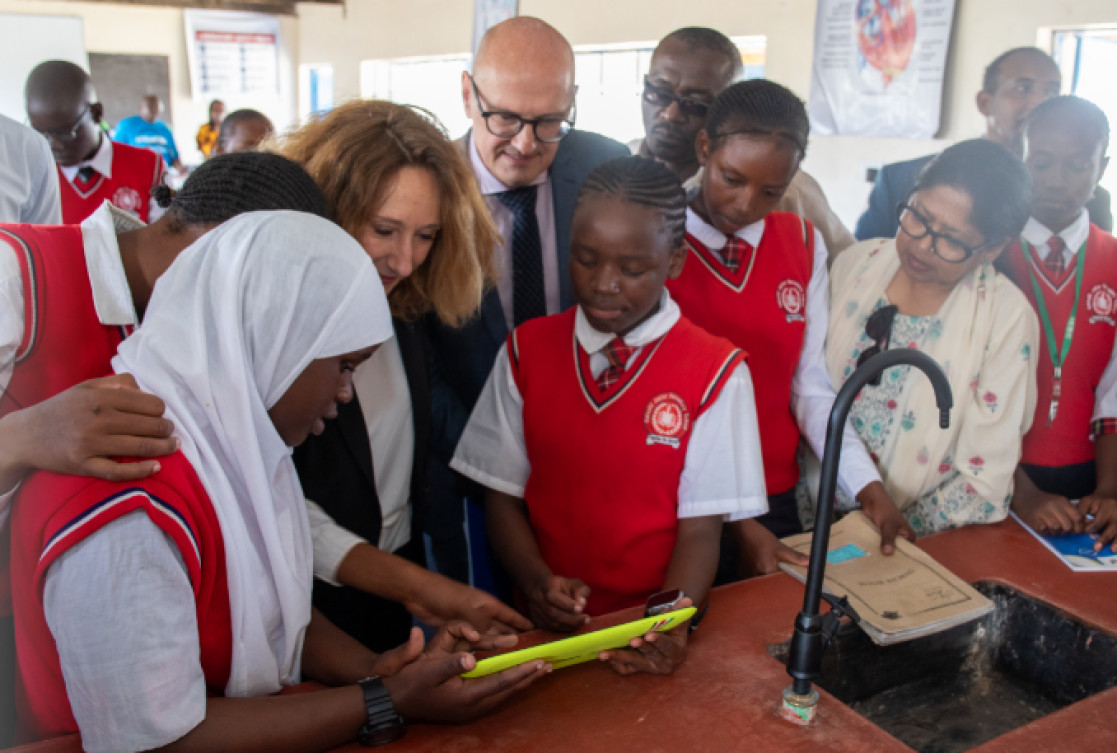
At least 363 public primary schools across Kenya now have internet access following the rollout of a European Union-funded digital learning programme aimed at improving education in rural and underserved areas.
The programme, known as the Last Mile Connectivity of Schools Project, was launched in October 2023 and targets 1,000 public primary schools in 14 counties. It supports digital learning under Kenya’s Competency-Based Curriculum (CBC).
Schools in remote parts of the country are already feeling the impact. At Enkasiti Primary School in Kajiado County, learners and teachers are accessing online learning resources for the first time after the school was connected to stable internet.
So far, more than 277,000 pupils have accessed digital learning content through the project, according to programme data.
The initiative has also supported inclusive education. About 2,800 learners with disabilities have benefited from assistive digital tools designed to meet their learning needs.
Teachers say the internet has changed how lessons are delivered. Joseph Kamau, a teacher at Enkasiti Primary School, said online access allows learners to take part in virtual experiments and simulations.
“With the internet, we can stream lessons and use virtual lab programmes where pupils carry out experiments without needing physical equipment,” he said.
Teachers have also benefited from the programme. More than 4,400 teachers have been supported to use digital tools in class, while hundreds have received ICT training to improve their skills.
The project is part of the European Union’s Digital Economy Package for Kenya, implemented under the Global Gateway Strategy, which focuses on improving digital infrastructure and skills.
EU Deputy Director-General Myriam Ferran said the project is already making a difference, noting that over 400 teachers have received ICT training in the first phase.
“Our goal is to reach 1,000 schools by the end of the year,” she said, adding that learners are showing better engagement and improved learning outcomes.
As the project continues, it is expected to help reduce the digital gap in education and ensure learners in remote areas are not left behind.