Kenya is targeting an additional one million acres of land under irrigation over the next decade under a USD 4.6 billion plan aimed at strengthening food and water security, improving agricultural productivity and building resilience to climate change.
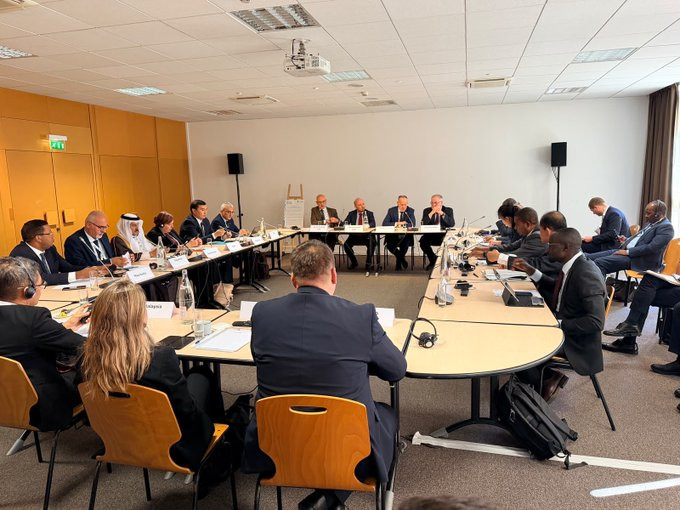
Water, Sanitation and Irrigation Cabinet Secretary Eng. Eric Mugaa announced the strategy while attending the 26th International Commission on Irrigation and Drainage (ICID) Congress in Marseille, France, where ministers and irrigation experts discussed the role of water management in sustainable agriculture.
During a high-level session chaired by the ICID President, Mugaa outlined the government’s efforts under the National Irrigation Sector Investment Plan (NISIP), which seeks to expand irrigation coverage, improve the performance of public irrigation schemes and help communities adapt to changing climatic conditions.
The plan aims to mobilise approximately USD 4.60 billion over 10 years, with 61 per cent expected to come from private investment and 39 per cent from public funding.
The investment strategy is intended to increase the area under irrigation by one million acres, creating opportunities for farmers to expand production beyond dependence on rainfall.
Under NISIP, the government has identified five pathways for expanding irrigation and improving agricultural water management. These include farmer-led irrigation, high-performing public irrigation schemes, corporate agribusiness, revitalised irrigation in arid and semi-arid lands, and expanded and optimised community irrigation schemes.
The approach seeks to combine public investment, private-sector participation and community-led initiatives to increase agricultural production while improving the use of available water resources.
Farmer-led irrigation is expected to support individual farmers and agricultural enterprises in developing irrigation systems suited to their production needs, while improvements to public schemes aim to strengthen the performance and reliability of existing infrastructure.
The strategy also places emphasis on corporate agribusiness investment and the revival of irrigation projects in arid and semi-arid areas, where unreliable rainfall often constrains agricultural activities.
Community irrigation schemes form another pillar of the plan, with the government seeking to expand access to irrigation infrastructure and improve the management of water resources at the local level.
At the Marseille congress, participating delegates endorsed the Marseille Call, which urges governments and stakeholders to align agricultural systems with water availability, soil conditions and climate realities.
The declaration also calls for agriculture to become a responsible steward of water and land resources, alongside improved planning and management of resilient and diversified agricultural water systems.
Other priorities outlined in the Call include mobilising financing for sustainable agricultural water management and empowering communities through knowledge, data and innovation.
Mugaa said Kenya supported the shared priorities and called on governments, development partners, farmers, water-user organisations, civil society and the private sector to work together to transform agriculture through irrigation.
The government’s irrigation expansion agenda comes amid growing concerns about the effects of climate variability on food production and the livelihoods of farming communities.
Expanding irrigation can help farmers maintain production during dry periods, support multiple planting seasons and reduce the risks associated with unpredictable rainfall. However, achieving these benefits will depend on effective project implementation, sustainable water allocation, financing and the maintenance of irrigation infrastructure.
The proposed USD 4.6 billion investment will require coordination between public institutions, private investors and local communities to deliver the targeted additional irrigated acreage over the next decade.
Through NISIP and its participation in international irrigation discussions, Kenya is seeking to strengthen agricultural water management as part of its broader efforts to improve food security, increase farm productivity and build climate resilience.