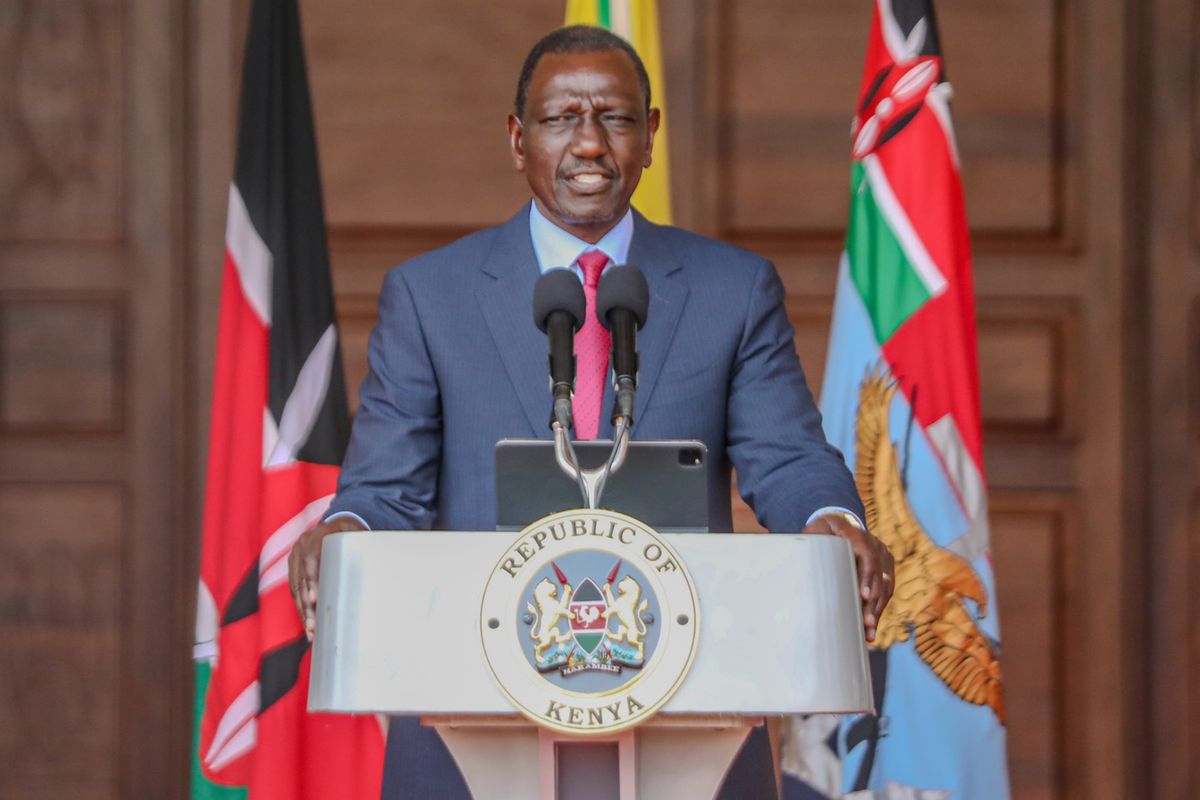
The battle for Mt Kenya ahead of the August 2027 General Election is increasingly taking shape, with President William Ruto and his Deputy, Kithure Kindiki, pursuing a political strategy that is markedly different from the one that secured them overwhelming support in 2022.
For Ruto, the challenge is to retain a region that played a decisive role in his presidential victory. For Kindiki, the task is even more complicated: he must translate his position as Deputy President into political influence, rebuild relationships with grassroots leaders and convince Mt Kenya voters that the region still has a meaningful stake in the Kenya Kwanza administration.
Unlike the 2022 campaign, when Ruto benefited from a largely united Mt Kenya political establishment, the 2027 contest is likely to be fought against a divided political landscape, with Rigathi Gachagua’s Democracy for the Citizens Party (DCP) seeking to establish itself as an alternative political vehicle.
The emerging contest is therefore not simply about who commands the largest political rallies. It is about who can control the political narrative, influence local leadership, maintain grassroots networks and convince voters that their interests are best protected by their preferred political camp.
Ruto’s strategy: Development, political networks and continuity
Ruto appears to have settled on a strategy that combines government development programmes with political mobilisation. Rather than relying exclusively on traditional political heavyweights, the President is using a combination of elected leaders, Cabinet Secretaries, technocrats, business figures and grassroots organisers to rebuild his political network.
The approach is designed to remind Mt Kenya voters that the region remains part of the national government’s development agenda. Roads, markets, affordable housing, electricity, agricultural programmes, education and employment opportunities have become important features of his engagements.
There is also a political calculation behind the development tours. By taking government projects directly to communities, Ruto is seeking to counter the opposition narrative that Mt Kenya lost its influence following Gachagua’s removal from office.
The President is also strengthening UDA structures and encouraging local leaders to defend his administration’s record. This gives him an opportunity to build a political network that does not depend entirely on one individual.
But Ruto’s biggest advantage could also become his biggest vulnerability. Government development projects do not automatically translate into electoral loyalty, particularly when voters have economic grievances or feel politically sidelined.
Kindiki’s assignment: Rebuilding the bridge to Mt Kenya
Kindiki is arguably the most important figure in Ruto’s Mt Kenya strategy.
His approach differs from Gachagua’s confrontational political style. The Deputy President has increasingly focused on engaging elders, church leaders, professionals, business communities, youth groups and grassroots political organisers.
His September 19, 2026, meeting at Kirigiti Stadium in Kiambu, where approximately 30,000 GEMA elders endorsed him as the region’s spokesperson, was particularly significant.
The gathering was an attempt to establish a new political centre around Kindiki and position him as the link between Mt Kenya and the national government.
However, the endorsement also exposed the difficulties facing his mission. Some leaders questioned whether a gathering dominated by elders from Mt Kenya East could speak for the entire region, particularly without adequate consultation with Mt Kenya West leaders. the-star.co.ke +1
Kindiki has also invested heavily in party organisation. His meetings with thousands of UDA polling centre officials in Meru and Embu demonstrate that his mission goes beyond public rallies.
He understands that elections are won through organised grassroots structures, local mobilisation and the ability to reach voters at polling station level.
His other major selling point is the 2032 argument. Kindiki has been telling Mt Kenya leaders that supporting Ruto for a second term would position the region favourably for a possible presidential contest in 2032.
This is a clever political proposition because it gives the region a reason to remain within government rather than gamble on an uncertain opposition arrangement.
However, it also requires voters to postpone their immediate political expectations in exchange for a promise of future influence.
The battle over who speaks for Mt Kenya
Perhaps the most important dimension of the emerging contest is the struggle over political leadership of the Mountain.
Gachagua has built his influence around the argument that Mt Kenya must negotiate with the national government as a united political bloc. His DCP party is seeking to turn that message into an electoral movement.
Kindiki, on the other hand, is presenting himself as a bridge between the region and the government, arguing that political isolation would deny Mt Kenya development opportunities and national influence.
The two approaches represent competing political philosophies.
Gachagua wants the region to exercise its political bargaining power from outside the government if necessary, while Kindiki believes remaining within government provides a better opportunity to secure its interests.
But neither approach has secured an uncontested mandate.
The emergence of other political formations associated with Ndindi Nyoro, Fred Matiang’i, Martha Karua, Peter Munya and Justin Muturi means the Mt Kenya contest is becoming more complicated than a straightforward Ruto-versus-Gachagua battle. beta.the-star.co.ke
The weakness in Ruto and Kindiki’s strategy
The biggest test for the President and his Deputy is whether their political mobilisation can overcome voter dissatisfaction.
A November 2026 TIFA survey on party preferences in Mt Kenya, reported by The Star, placed DCP at 27 per cent, Linda Mwananchi at 15 per cent and UDA at 10 per cent. While party preference does not necessarily translate into presidential voting intentions, the findings illustrate the challenge facing the ruling party in rebuilding its regional support. the-star.co.ke
There is also the risk of over-relying on political endorsements, large gatherings and declarations by influential community figures.
Mt Kenya voters have historically demonstrated that they can abandon political establishments when they believe their interests are not being served. The same electorate that overwhelmingly backed Ruto in 2022 could make a different calculation in 2027.
Kindiki must therefore demonstrate that his engagements are producing tangible political goodwill rather than simply generating impressive photographs and attendance figures.
Ruto, meanwhile, must address the economic and political grievances that have created room for Gachagua and other opposition figures to mobilise against his administration.
The 2027 calculation
Ultimately, Ruto and Kindiki are pursuing a strategy built around three pillars: development delivery, grassroots political organisation and the promise of continued regional influence within government.
Gachagua’s counterstrategy is built around political bargaining power, regional identity and opposition mobilisation.
Both camps understand that Mt Kenya remains strategically important, not just because of its voting numbers but also because of its ability to influence national political alliances.
However, the region is no longer operating under the political conditions that existed in 2022. Its leadership is divided, several political parties are competing for influence, and voters are increasingly being presented with alternative political choices.
My take: Ruto is betting that development, government access and Kindiki’s grassroots networks will gradually restore his political standing in Mt Kenya. Kindiki is betting that he can become the region’s acceptable link to State House and eventually inherit a larger political constituency. Gachagua, meanwhile, is betting that the grievances surrounding his impeachment can sustain an opposition movement powerful enough to challenge the government.
The biggest question is whether Kindiki can turn government authority into grassroots political authority before the election.
Because in Mt Kenya, having the Deputy President’s office, access to State House and the backing of community elders may help open political doors. But ultimately, it is the voters who decide who speaks for the Mountain.