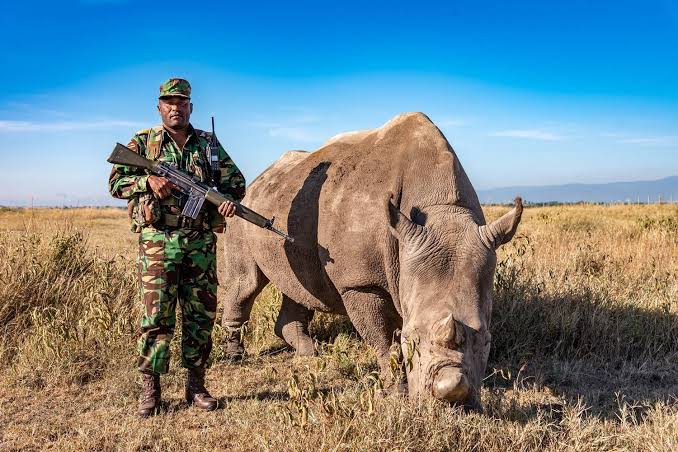
Ol Pejeta Conservancy has called for coordinated efforts to expand secure wildlife habitats and strengthen rhino population management following the deaths of 17 black rhinos recorded between February and November 2026.
The conservancy said all the reported deaths were caused by natural factors, ruling out poaching, with no poaching incidents recorded within its boundaries.
In a statement, Ol Pejeta said the losses highlighted growing ecological pressures on rhino populations, including declining food availability, prolonged dry conditions and increasing competition for natural resources.
The conservancy, which plays a significant role in Kenya’s black rhino recovery programme, reported an average annual population growth of approximately 5.5 per cent since its last rhino introduction in 2007.
Its November management records listed 179 eastern black rhinos, 55 southern white rhinos and two northern white rhinos.
Working alongside the Kenya Wildlife Service (KWS) and other conservation partners, Ol Pejeta has contributed to the recovery of Kenya’s rhino population from approximately 380 animals in the late 1980s to more than 1,200 in 2026.
The recovery has also enabled the conservancy to support rhino conservation beyond its boundaries, with animals from Ol Pejeta helping establish populations at Loisaba in 2024 and Segera in 2025.
However, the conservancy warned that sustaining the gains required urgent attention to habitat quality, food availability and the health of individual animals.
According to its mortality records, the 17 deaths included five cases of confirmed or suspected lion predation, four attributed to old age, two linked to downer syndrome, two caused by disease and one drowning incident.
The causes of three other deaths remain undetermined, while the conservancy said all the recovered horns had been safely secured and stored by KWS.
Ol Pejeta Board Chairman Philip Coulson said the conservancy was working with relevant authorities to establish the circumstances surrounding the deaths and verify the population records.
“We deeply regret the loss of each rhino. Our records show that 17 black rhinos died between 26 February and 12th November 2026,” Coulson said.
He added that field teams were also investigating the status of two additional calves that had not been recently sighted.
Habitat pressure threatens conservation gains
The conservancy’s internal assessments indicate that its black rhino population has exceeded the estimated 120 animals its habitat can sustainably support.
The Wildlife Research and Training Institute (WRTI) is currently undertaking an assessment to establish the conservancy’s ecological carrying capacity.
The findings point to a significant decline in whistling thorn acacia, an important food source for black rhinos, with losses exceeding 80 per cent across the conservancy and 90 per cent in its eastern section.
The assessments attribute the pressure partly to sustained browsing by wildlife and the spread of less palatable Euclea divinorum bush, which has affected the availability of suitable food.
Dry weather conditions have further compounded the challenge, with rainfall recorded between April and October 2026 standing at 298.4 millimetres, approximately 56 per cent of the 528.8-millimetre average recorded during the same period between 2020 and 2025.
The conservancy said declining habitat conditions were particularly concerning for older rhinos and animals experiencing deteriorating body conditions, although the ecological pressures could not conclusively explain every recorded death.
Habitat restoration and veterinary interventions
Ol Pejeta said it had introduced several interventions to restore vegetation, improve food availability and support vulnerable animals.
“We have set aside an exclusion zone to help acacia trees recover and planted more than 10,000 seedlings to restore food for rhinos,” Coulson said.
He added that the conservancy was providing supplementary food and veterinary care to animals requiring additional support while closely monitoring their health.
The conservancy has also secured funding for research into rhino feeding patterns and nutritional requirements to strengthen future conservation and population management strategies.
In August, Ol Pejeta, working with KWS, translocated 18 lions as part of efforts to reduce predation pressure on rhinos.
It is also seeking continued collaboration with KWS, WRTI and other conservation partners to identify suitable habitats for future rhino translocations.
The conservancy said expanding rhino habitats would require suitable vegetation, reliable water sources, security arrangements and sustainable funding for veterinary services and wildlife monitoring.
It further emphasised the importance of involving local communities and landholders in conservation programmes, noting that long-term recovery depended on cooperation across wildlife landscapes.
Ol Pejeta said its immediate priority was to protect the remaining rhinos, establish the circumstances surrounding the reported deaths and use scientific findings to guide future conservation interventions.
The conservancy maintained that sustaining Kenya’s rhino recovery would require population growth to be matched by adequate habitat, food resources and effective wildlife management.