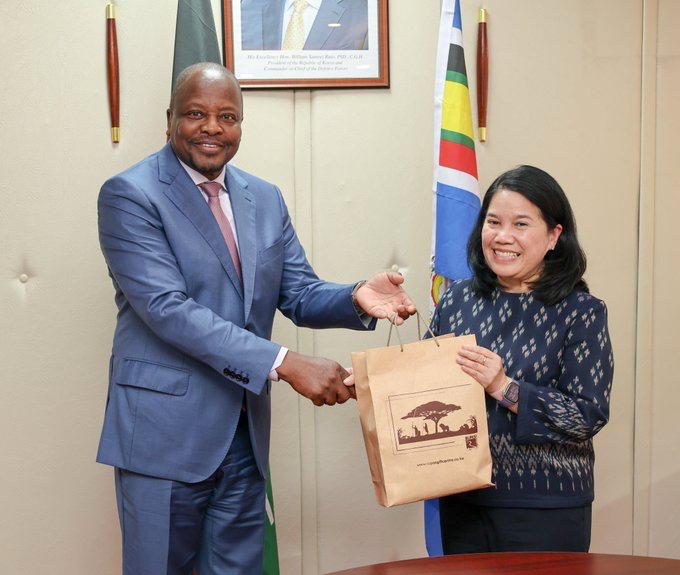
Kenya is seeking to increase its agricultural exports to Thailand while encouraging investors from the Asian country to set up agro-processing businesses locally.
The plans emerged during a meeting between Agriculture Cabinet Secretary Mutahi Kagwe and Thailand’s Ambassador to Kenya, Jirusaya Birananda, where the two discussed ways to expand cooperation in farming, trade, investment and skills development.
Kagwe identified coffee, tea and avocados as some of the Kenyan products with potential to reach more Thai consumers. He said Kenya was already working through the Kenya Plant Health Inspectorate Service (KEPHIS) to secure access for its avocados in the Thai market.
The CS said Kenya wanted to grow its tea and coffee exports while introducing more agricultural products to international markets.
He also asked Thai investors to consider setting up processing businesses in Kenya instead of simply buying raw agricultural produce and exporting it for processing elsewhere.
Kagwe said such investments would allow more value to be added to Kenyan products locally before they are sold in Thailand and other markets in the region.
He pointed to opportunities for businesses to establish enterprises that process agricultural produce, saying Kenya could serve as a production and processing centre for the wider region.
The discussions also covered training and exchange programmes for farmers and agricultural students from both countries.
Kagwe proposed closer links between agricultural training institutions in Kenya and Thailand, as well as more opportunities for students to learn from each other’s farming systems.
He said the existing training partnership should be expanded to reach more people, including farmers who could benefit from practical lessons on new technologies and production methods.
The CS further proposed short-term visits where Kenyan and Thai farmers could travel to each other’s countries to share experiences and learn how to deal with challenges affecting agriculture in tropical regions.
He said the exchanges should involve larger groups of farmers rather than just a few trainees if they were to make a meaningful difference at the farm level.
Ambassador Birananda welcomed the proposals, saying agriculture offered room for closer cooperation under Thailand’s recently launched Thailand-Africa Initiative, which identifies Kenya as an important partner in its engagement with the continent.
She also called for more direct trade between the two countries, saying official figures might not fully reflect the amount of Kenyan produce reaching Thailand.
According to the Ambassador, some Kenyan products, including coffee, tea and flowers, reach Thai buyers through third-party trading centres such as Dubai. As a result, their country of origin may not always be recorded as Kenya in trade statistics.
She said both countries needed to find ways of strengthening direct trade arrangements so that Kenyan exports could reach the Thai market more directly.
Coffee was singled out as one of the products with strong potential. Birananda noted that Thailand’s local coffee production was not enough to meet the needs of its growing coffee industry, creating an opportunity for Kenyan coffee producers to supply more of the market.
The Ambassador also identified areas where Thai investors could partner with Kenyan businesses, including food processing, packaging, cold-chain facilities, logistics and transportation.
The proposed partnership is expected to cover several stages of the agricultural value chain, from production and farmer training to processing and access to international markets.