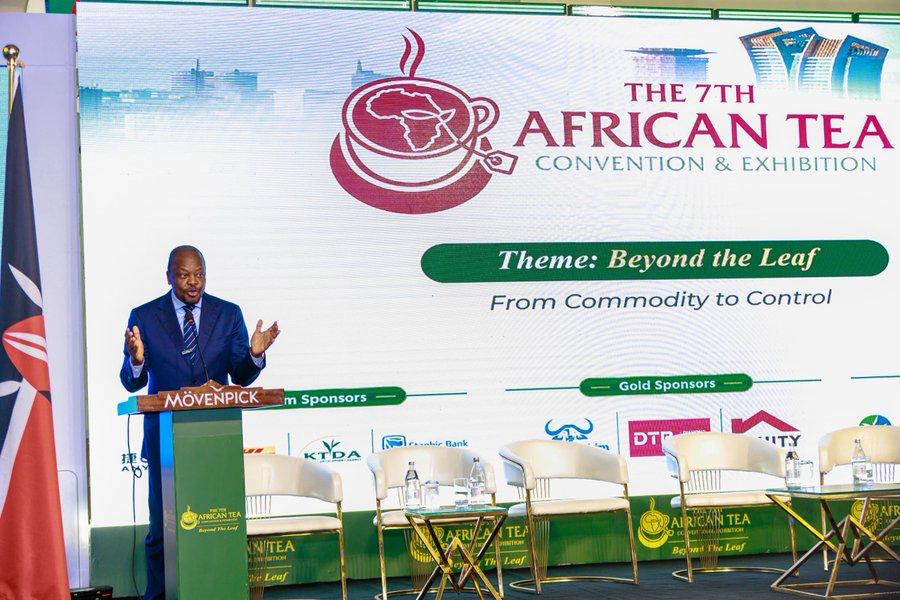
Agriculture Cabinet Secretary Mutahi Kagwe has called for changes in Kenya’s tea industry, saying farmers should benefit more from the crop through value addition, new markets and better trade opportunities.
Kagwe said the country needs to move away from relying mainly on bulk tea exports and instead invest more in processing and branding locally.
Speaking at the opening of the 7th Africa Tea Convention 2026, the CS said the future of the tea sector must start with the farmers who depend on the crop for their livelihoods.
“It all begins with the farmers,” Kagwe said, questioning how much tea growers actually gain from the sale of their produce.
He noted that the tea industry supports millions of livelihoods, including people who are not directly involved in growing the crop.
Kagwe also called for Kenya to find more markets for its tea instead of depending heavily on traditional destinations.
He identified Pakistan as one of Kenya’s key business partners and welcomed China’s decision to remove duties on tea entering its market.
The CS said China presents a major opportunity for Kenyan tea, including products that are processed into different forms.
However, he said finding new markets should go hand in hand with increasing the amount of tea processed within Africa.
“It makes no sense to sell bulk tea to Europe and then follow the jobs to Europe that we ought to have created here,” Kagwe said.
He urged investors and farmers to put more money into tea factories, modern machinery and technology, while also expanding the range of tea varieties produced in the country.
Kagwe said farmers should work closely with processors to produce tea that meets the needs of different markets and attracts better returns.
He also encouraged farmers and investors to take advantage of the government’s land commercialisation initiative to expand tea production and create more opportunities along the value chain.
On regional trade, Kagwe called for stronger implementation of the African Continental Free Trade Area (AfCFTA), saying African countries need to reduce barriers that make it difficult for goods to move across borders.
He also pushed for lower taxes on processed agricultural products, arguing that value-added tea should be zero-rated to encourage more processing, manufacturing and investment within Africa.
The CS said Kenya’s focus should not only be on producing more tea but also on processing more of it locally, developing African brands and ensuring farmers receive a larger share of the value created.
More than 800 delegates from 26 tea-producing and consuming markets are attending the three-day convention hosted by the East Africa Tea Trade Association (EATTA).
The convention is being held alongside celebrations marking the 70th anniversary of the East African Tea Trade Auction.
EATTA has members from 10 countries and runs the world’s largest black CTC tea auction, accounting for about 32 per cent of global tea exports.
Kagwe attended the event alongside Agriculture Principal Secretary Paul Rono, Trade Principal Secretary Regina Ombam, Tea Board of Kenya CEO Willy Mutai, EATTA Chairman Robert Koech, EATTA CEO George Omuga and other officials.