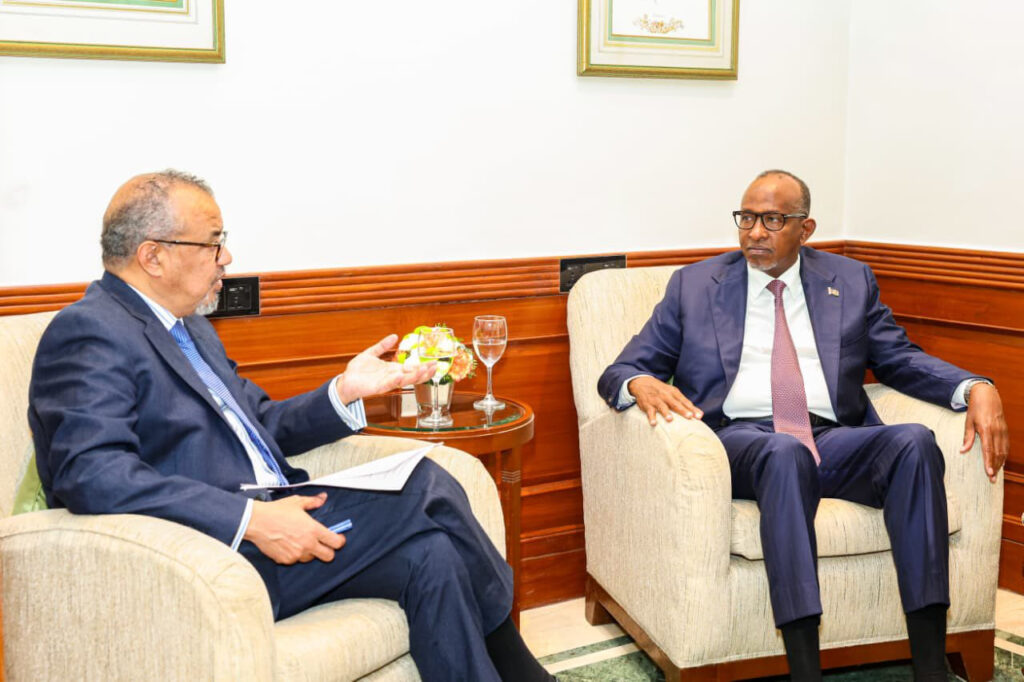
Health Cabinet Secretary Aden Duale has called for sustained technical assistance from the World Health Organization (WHO), particularly in training and capacity building across critical regulatory functions for medicines and vaccines.
In a statement released on Friday, the Ministry of Health said Duale made the remarks during a bilateral meeting with WHO Director-General Dr Tedros Adhanom Ghebreyesus on the sidelines of the Second WHO Global Summit on Traditional Medicine currently underway in India.
Duale praised WHO’s continued technical and political support to President William Ruto, saying early high-level engagements had reinforced confidence within government that the UN health agency remains a reliable and strategic partner.
He reaffirmed Kenya’s appreciation for WHO’s long-standing collaboration in health, science and innovation, while emphasizing the country’s intention to move beyond traditional aid-based cooperation.
“Our priority is to advance technology transfer, industrial collaboration, and sustainable systems strengthening,” Duale said, noting that the approach aligns with President Ruto’s role as African Union Champion for Local Manufacturing.
According to the ministry, the Cabinet Secretary highlighted reforms aimed at strengthening local pharmaceutical manufacturing, including a six-month accelerated regulatory evaluation timeline and reduced fees for locally produced medicines. These measures have attracted 13 new pharmaceutical manufacturers into the Kenyan market.
Duale also outlined Kenya’s progress towards attaining WHO Maturity Level 3 status by 2026, supported by the implementation of Institutional Development Plans. An updated progress report is expected by January 2026, with a re-benchmarking mission planned for March 2026.
He urged WHO to continue supporting the training of regulators and strengthening oversight capacity for medicines and vaccines as Kenya builds a robust and credible regulatory system.
The Cabinet Secretary further underscored the need to enhance emergency preparedness and response in the face of rising global risks such as climate change, calling for stronger surveillance systems, early warning mechanisms and a well-prepared health workforce.