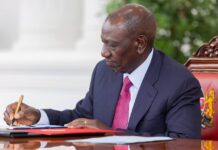
Kenya and United Kingdom have renewed their strategic partnership, welcoming more opportunities between two nations.
The strategic partnership is rooted in four key pillars including: trade and investment, green growth and climate action, science and technology, and peace and security, the partnership sets out to double bilateral trade by 2030, provide digital skills training to 2.5 million Kenyans, and strengthen cooperation on regional stability, counterterrorism, cybersecurity, and climate resilience.
The pact, which succeeds the 2020–2025 framework, is also expected to deliver growth in Information and Communication Technology.
During the signing of strategic partnership, President Ruto comended UK government for KSh 17.7 billion set to support Kenya’s rapidly expanding innovation ecosystem. The funding is expected to benefit over 500 tech start-ups, support 5,000 digital-focused small and medium enterprises (SMEs), and generate more than 30,000 digital jobs.
The two nations also committed to deepening collaboration in artificial intelligence (AI) and other advanced technologies, with a view to promoting inclusive, sustainable digital growth across East Africa.The UK also pledged to mobilise up to KSh 266.1 billion in new investments across Kenya, alongside facilitating KSh 32.3 billion in capital markets funding to spur development across strategic sectors by 2030.
In a strong demonstration of economic and people-to-people ties, Kenya and the UK have agreed to an additional six weekly Kenya Airways flights between Nairobi and London, starting this week, to unlock the persistent cargo and passenger challenges.
This expansion signals the deepening commercial and tourism links between the two nations. Kenya and UK have agreed to expand cooperation between security and defence agencies through intelligence sharing, capacity building, and joint operations.
According to both leaders, Defence Cooperation Agreement (DCA) will be signed subsequently, grounded in mutual respect for the legal frameworks of both nations.
To booat security, the two leaders also committed to support regional peace and security initiatives, including the stabilisation of South Sudan, exploring a new framework for resolving the crisis in Sudan, and strengthening support for Somalia.
This bilateral partnership emphasised the importance of harmonising regional responses through the East African Community (EAC) and Southern African Development Community (SADC).
The two nation reaffirmed commitment in the Multinational Security Support Mission in Haiti, agreeing to support the mission.