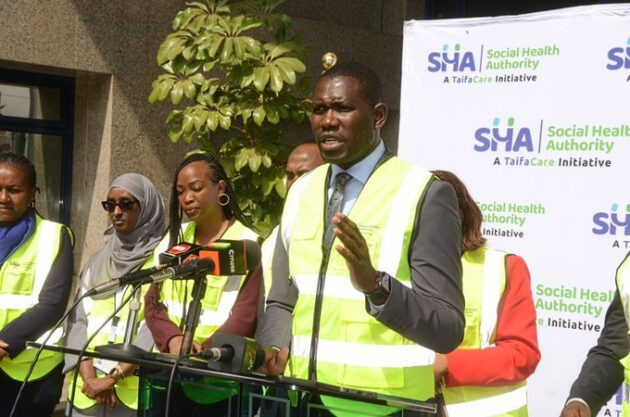
The government has launched an aggressive compliance drive to recover more than Sh3 billion in unpaid statutory health contributions from over 12,900 employers in Nairobi, in a major push to safeguard funding for Kenya’s new Social Health Authority (SHA).
Speaking at the SHA headquarters during the unveiling of the SHA Rapid Results Compliance Initiative, Medical Services Principal Secretary Dr. Ouma Oluga warned that the government is taking decisive steps against employers who have failed to remit the mandatory 2.75% monthly health deduction as required under the SHA framework.
“The initiative in Nairobi alone is targeting recovery of over Sh3 billion from 12,900 non-compliant employers,” said Oluga. “Employers must remit the 2.75% health deduction monthly or face enforcement under the law.”
While public sector entities have largely complied, Oluga noted that many private employers have defaulted, posing a significant threat to the success of the country’s universal health coverage (UHC) goals.
“These funds are critical to ensure timely payments to hospitals and sustainability of health services. The SHA system is digital, transparent, and capable of real-time tracking,” he emphasized.
The SHA, which recently replaced the National Hospital Insurance Fund (NHIF), is Kenya’s new health financing platform and is central to the government’s efforts to deliver accessible and affordable healthcare to all citizens
To ease compliance—especially for the informal sector—Oluga introduced “Lipa SHA Pole Pole”, a flexible payment option aimed at supporting workers with irregular income streams.
The compliance drive will initially focus on Nairobi, but the Ministry of Health plans to expand enforcement operations to other counties including Kiambu, Kajiado, and beyond in the coming weeks.
“We urge all employers to cooperate with SHA officers and fulfill their legal obligations. A functioning health system requires collective effort,” Oluga said.
According to the Ministry of Health, more than 24 million Kenyans have already enrolled in SHA, marking a significant milestone toward realizing universal health coverage under the Kenya Kwanza administration.
As the compliance initiative gains momentum, officials say that ensuring full participation by employers is not just a legal mandate—but a moral one, with direct impact on the quality, accessibility, and reliability of healthcare services nationwide.
“This is not about punishment—it’s about building a system where every Kenyan, regardless of income, has access to decent healthcare,” Oluga concluded.