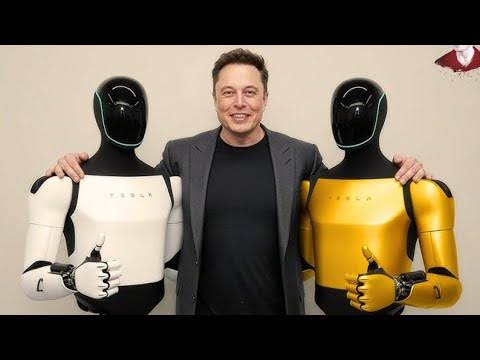
Elon Musk has reportedly prepared an ambitious new training program called “Optimus Academy,” where 10,000 to 20,000 humanoid robots could learn how to perform real world tasks together.
Musk argued that the training is surprisingly similar to raising a child.
“Think of it like a school for robots, except instead of studying textbooks, they would practice physical activities, make mistakes, and gradually improve through experience. The idea is to use a training method called self-play, allowing thousands of Optimus robots to generate valuable data that can help improve the artificial intelligence controlling them,” Musk said.
He added most of the equipment for that capacity is already in Fremont, with output set to climb toward roughly 20,000 robots a week as the line ramps.
The growth of Optimus is an S curve, but the initial curve is a shallow slope. The team is now refining the robot’s AI, electromechanical design, reliability and service life.
Musk said he expects that the work to be finished by the end of next year when Tesla plans to start delivering Optimus to outside companies for dangerous, repetitive and around the clock jobs.
Tesla has publicly pursued the development of its Optimus humanoid robot, but is different from confirming the existence of a dedicated academy for training robots.
Tesla has already collected data from its cars to improve their driving software, but Optimus does not yet have a comparable fleet generating real-world training data.
Ashok Elluswamy, who leads Tesla’s AI software team, said the robots would initially learn by watching humans perform tasks.
“We have to bootstrap it by making the robots and having them do self-play, which is really how a human learns to navigate the world,” Ashok said.
Musk said Tesla could release a video in the next month or two showing Optimus performing tasks that have not been pre-programmed.
The company’s AI5 chip, which he said should offer around 10 times the computing power of the current AI4, is expected to enter the robot around April 2027.
Tesla is not the only company testing humanoid robots in industrial settings. A competing robot recently completed an eight-hour shift at a Siemens factory in Germany, showing how manufacturers are beginning to test the technology in real working environments.