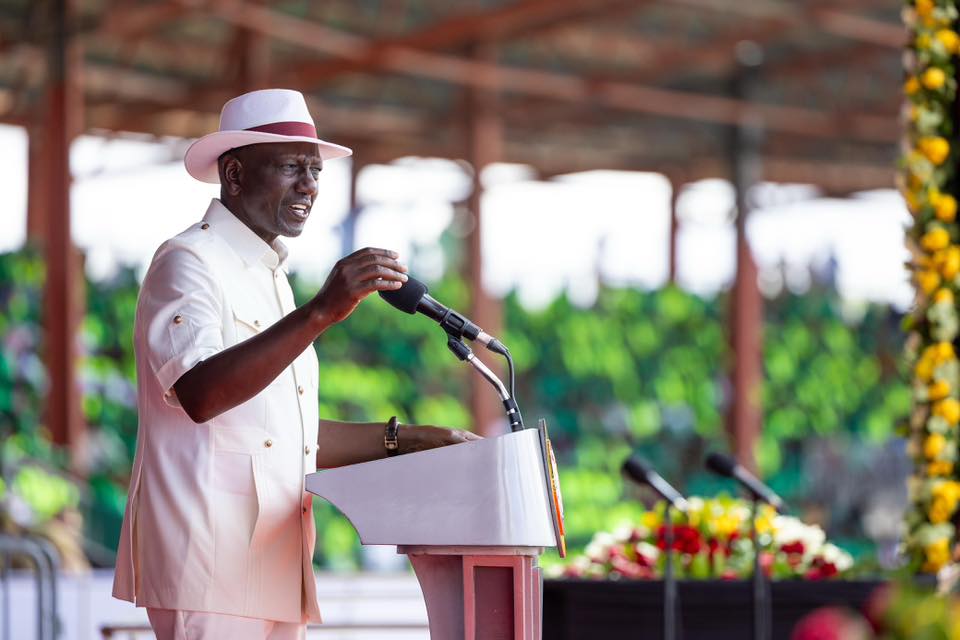
President William Ruto has outlined an ambitious plan to transform livestock farming in arid and semi-arid lands (ASAL), saying the sector remains central to both livelihoods and the national economy.
Speaking in Wajir during Madaraka Day celebrations, the president noted that livestock contributes about 12 percent of Kenya’s GDP and 42 percent of agricultural GDP, making it a critical pillar of rural development.
He announced that more than 52,000 sheep, goats and cattle have been distributed to over 10,000 households under the livestock restocking programme, helping families recover from drought-related losses. In addition, over 10 million animals have been vaccinated as part of expanded animal health interventions.
Ruto also highlighted improvements in veterinary infrastructure, including expanded vaccine production capacity and enhanced feed storage and market systems to support pastoralist economies.
He said 2,000 agripreneurs have been deployed across ASAL counties to provide last-mile agricultural advisory services, with 5,000 already active in supporting farmers. These efforts, he noted, are aimed at transitioning pastoralism into more resilient and commercially viable agriculture.
The president further reported that meat exports have increased by 84 percent, rising from kSh 8.9 billion in 2022 to KSh 16 billion in 2025. Milk production has also grown to 5.3 billion litres, signalling steady growth in the dairy sector.
He added that a KSh 5 billion county livestock investment initiative is being rolled out to support 350,000 pastoralists across 21 ASAL counties, with the potential to benefit over 2 million households through livestock value chains such as leather, meat and dairy processing.
Ruto also announced the operationalisation of the Livestock Enterprise Development Fund, establishment of a National Strategic Fodder Reserve, and the strengthening of pastoral cooperatives. The government is also set to fully roll out the Animal Identification and Traceability System (ANITRAC), and invest in the infrastructure needed to unlock premium export markets across Africa, the Middle East and beyond.
“We must move beyond live animal exports to higher-value products such as meat, leather, and
dairy. For too long, many looked at livestock and saw subsistence. We look at livestock and see enterprise. We see exports. We see jobs. We see wealth. And we see Northern Kenya becoming the gateway of Africa’s livestock trade to the Middle East and the wider world,” Ruto said.